What if the secret to timeless beauty isn't in a bottle — but in a ball of yarn?
The Anti-Trend Manifesto
Let's start with a rebellion.
Open any fashion magazine. Scroll any style feed. The message is the same: this season, wear this. Next season, wear that. Last season? Burn it. Forget it. It never happened.
We've built an entire industry on the fear of being outdated. Of wearing something that signals the "wrong" year, the "wrong" trend, the "wrong" version of ourselves. And in that frenzy of constant replacement, we've forgotten something ancient, something radical, something that beautiful women have known for centuries:
True style doesn't expire.
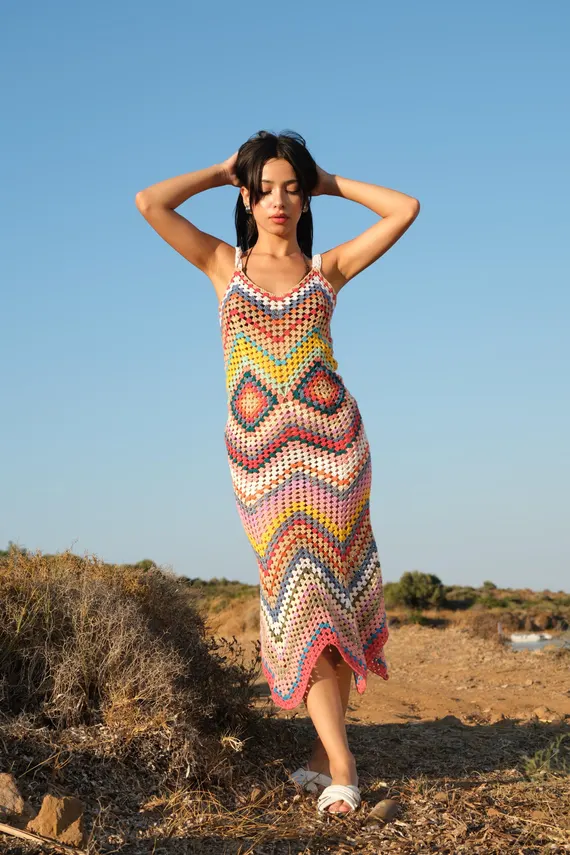
The woman in the multicolored crochet dress below — standing in golden sunlight against an empty landscape, her hands in her hair like she's posing for no one and everyone at once — isn't following a trend. She's following a thread. A lineage of makers and wearers that stretches back through generations. The zigzag pattern of her dress, the diamond motifs, the riot of sunset colors — these aren't from a runway. They're from someone's imagination. Someone's patience. Someone's hands.
This is the first secret of women who never stop wearing handmade: they understand that fashion is temporary, but craft is eternal. A machine-made dress has a season. A handmade dress has a soul.
Why Handmade Ages Backward
Here's the paradox that luxury brands don't want you to discover: handmade clothing gets more beautiful with time, not less.
Think about it. A silk blouse from a boutique arrives perfect — and then immediately begins its decline. The first snag. The first stain. The first moment you realize the fabric is thinner than it looked in the store. Its best day is its first day. Everything after is a slow goodbye.
A handmade crochet dress? It arrives with potential. The stitches are slightly uneven — not because of poor quality, but because of human hands. The yarn is natural — cotton, linen, wool — fibers that soften with washing, that mold to your body, that record your movements like a diary. The first time you wear it, it's good. The tenth time, it's better. The hundredth time, it's yours in a way no store-bought garment ever could be.
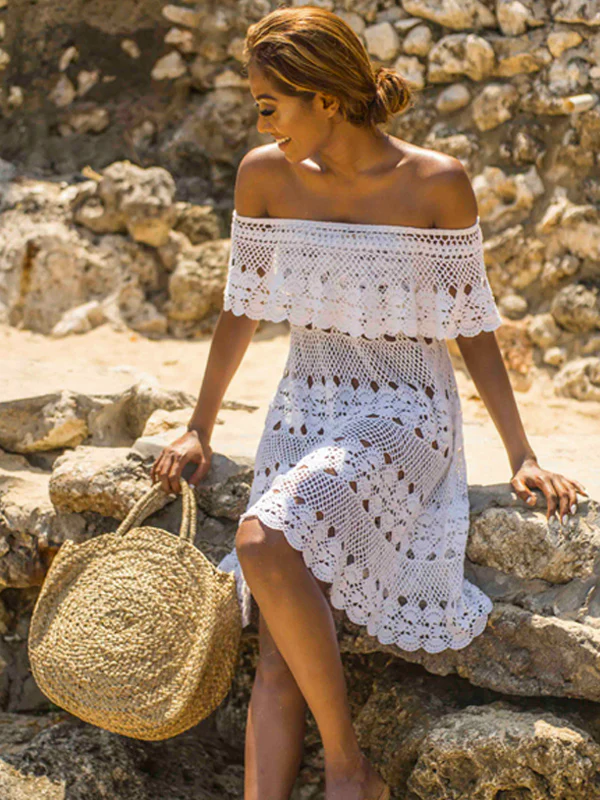
The white lace crochet dress below — with its off-shoulder ruffle, intricate floral openwork, and the quiet confidence of a woman sitting on sun-bleached rocks — proves this point. This isn't a dress for one occasion. It's a dress for a life. For gallery openings and grocery runs. For dates where you want to feel unforgettable and mornings where you want to feel like yourself.
Handmade ages backward because it starts with imperfection and grows into intimacy. The loose thread you tuck back in. The slight stretch where your shoulder rests. The color that fades not to ugliness, but to memory. These aren't flaws. They're the garment's autobiography. And beautiful women know that a story is always more interesting than a blank page.
The Confidence Equation: Why Craft Wears Better Than Couture
Let's talk about the invisible thing that handmade gives you: confidence that doesn't depend on a label.
When you wear designer fashion, you're borrowing confidence. It comes from the price tag, the logo, the recognition. Will they know this brand? Will they know what I spent? It's external validation wearing the mask of self-assurance.
When you wear handmade, the confidence is internal. It comes from knowing that your dress is one of a kind. That no algorithm generated it. That no factory produced ten thousand copies. That someone — maybe you, maybe a stranger on Etsy, maybe your grandmother — sat with yarn and time and made a series of decisions that resulted in this exact object on your body.
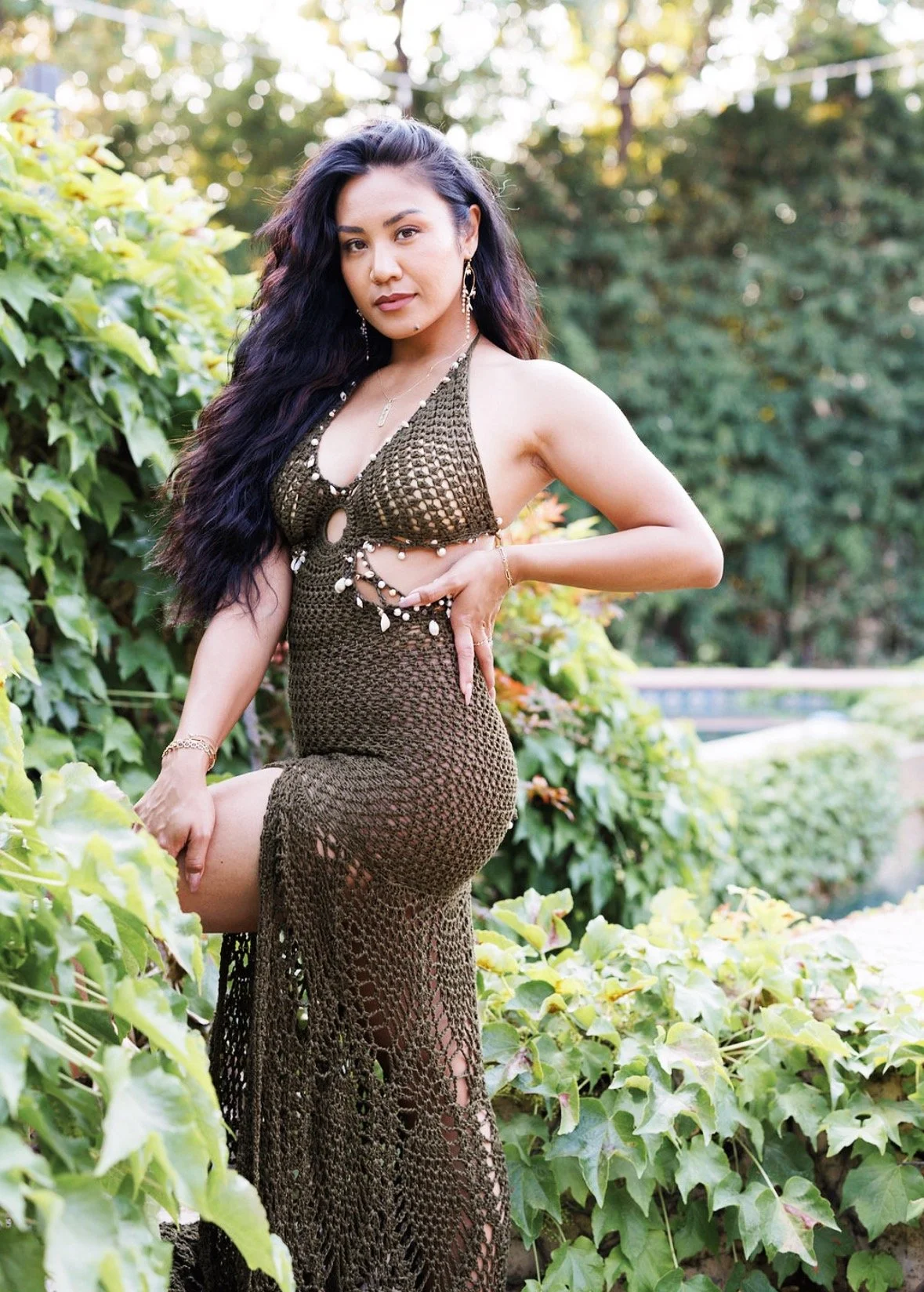
The olive green beaded crochet dress below — worn in a lush garden, the halter neckline adorned with shell details, the woman posing like she owns the natural world around her — carries this energy. She doesn't need a logo to prove her taste. The craftsmanship speaks. The uniqueness whispers. And the overall effect is unmistakable: this is a woman who understands that the most expensive thing she can wear is intention.
Beautiful women never stop wearing handmade because handmade never stops giving them this feeling. The feeling of being chosen, not marketed to. Of being seen, not advertised at. Of wearing something that carries a story rather than a strategy.
The Sustainability Plot Twist
Here's where logic gets flipped. We're told that sustainable fashion is about buying less, choosing better, investing in pieces that last. And then we're shown "sustainable" brands with $400 t-shirts made in the same factories as fast fashion.
Handmade is the real sustainability — and not just because it's better for the planet (though it is). It's sustainable because it's emotional. Because you don't get tired of it. Because you don't want to replace it. Because every time you put it on, you feel something that no new purchase can replicate.
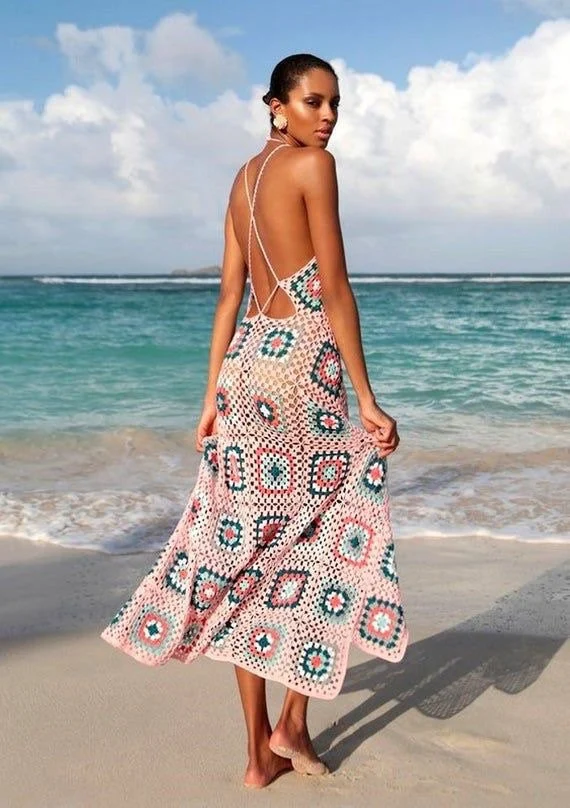
The granny square beach dress below — with its pastel pink and turquoise motifs, open back, and the freedom of a woman walking barefoot on sand — embodies this sustainability. This dress isn't just eco-friendly. It's ego-friendly. It doesn't demand attention. It invites it. It doesn't shout status. It radiates calm.
Beautiful women understand this math: one handmade dress that you love for ten years is worth more than twenty fast-fashion dresses that you forget in two weeks. Not because of the money saved. Because of the decisions unmade. The mental energy not spent on shopping. The closet space not cluttered with almost-rights. The peace that comes from knowing exactly what you own and exactly why you own it.
The Maker's Mark: Why Imperfection Is the Ultimate Luxury
Let's get technical for a moment. Because the physics of handmade create something no machine can replicate.
A factory garment is uniform. Every stitch identical. Every seam mathematically precise. This perfection is comforting — until you realize it's also anonymous. That same dress was made in thousands. Worn by hundreds. Belonged to no one.
Handmade carries the maker's mark. The loop that's slightly tighter. The edge that curves where a machine would force it straight. The color variation that comes from hand-dyeing rather than chemical consistency. These aren't errors. They're fingerprints. Proof that a human being, with all their fallibility and grace, decided this object should exist.
The baby blue and cream crochet dress below — with its geometric patterns, tassel hem, and the relaxed posture of a woman leaning against a wooden railing — carries this mark. Look closely at the diamonds. The hand-formed shapes. The slight irregularity of the tension. These are the credentials of craft. The proof that this dress wasn't produced — it was created.
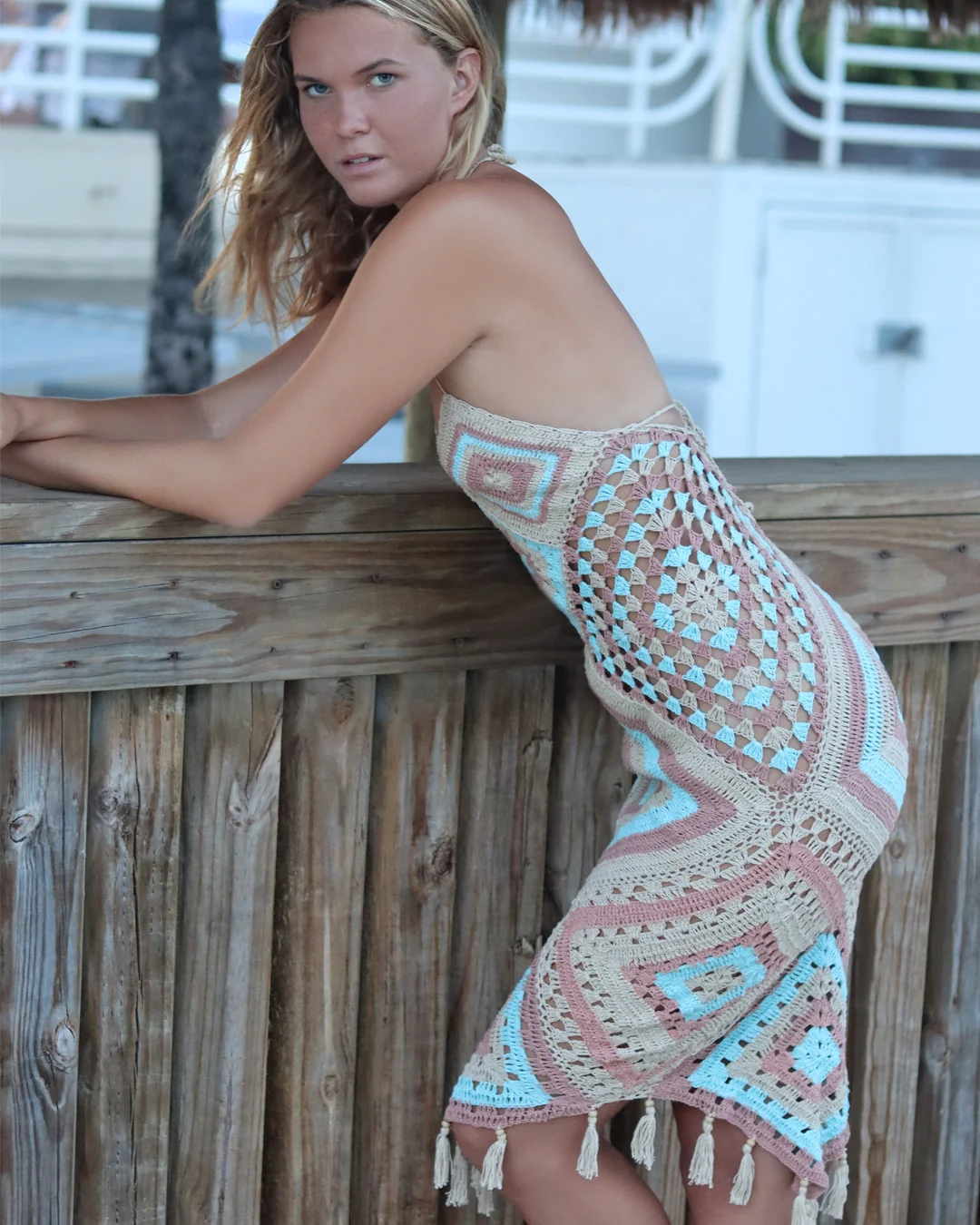
Beautiful women never stop wearing handmade because they understand that luxury isn't perfection. Luxury is personality. The kind that comes from knowing your dress has a history, a maker, a soul. The kind that makes you feel not just dressed, but chosen.
The Everyday Magic: Handmade Beyond Special Occasions
Here's the final secret, and it's the one that surprises people most: beautiful women wear handmade not just for weddings and vacations, but for Tuesdays.
The white floral crochet dress below — with its red flower accents, deep V-neckline, and the unapologetic stance of a woman who knows her own power — proves that handmade belongs in the everyday. This isn't a piece saved for "someday." This is a piece worn for today. For coffee with friends. For a walk in the park. For the simple, radical act of choosing beauty on an ordinary morning.
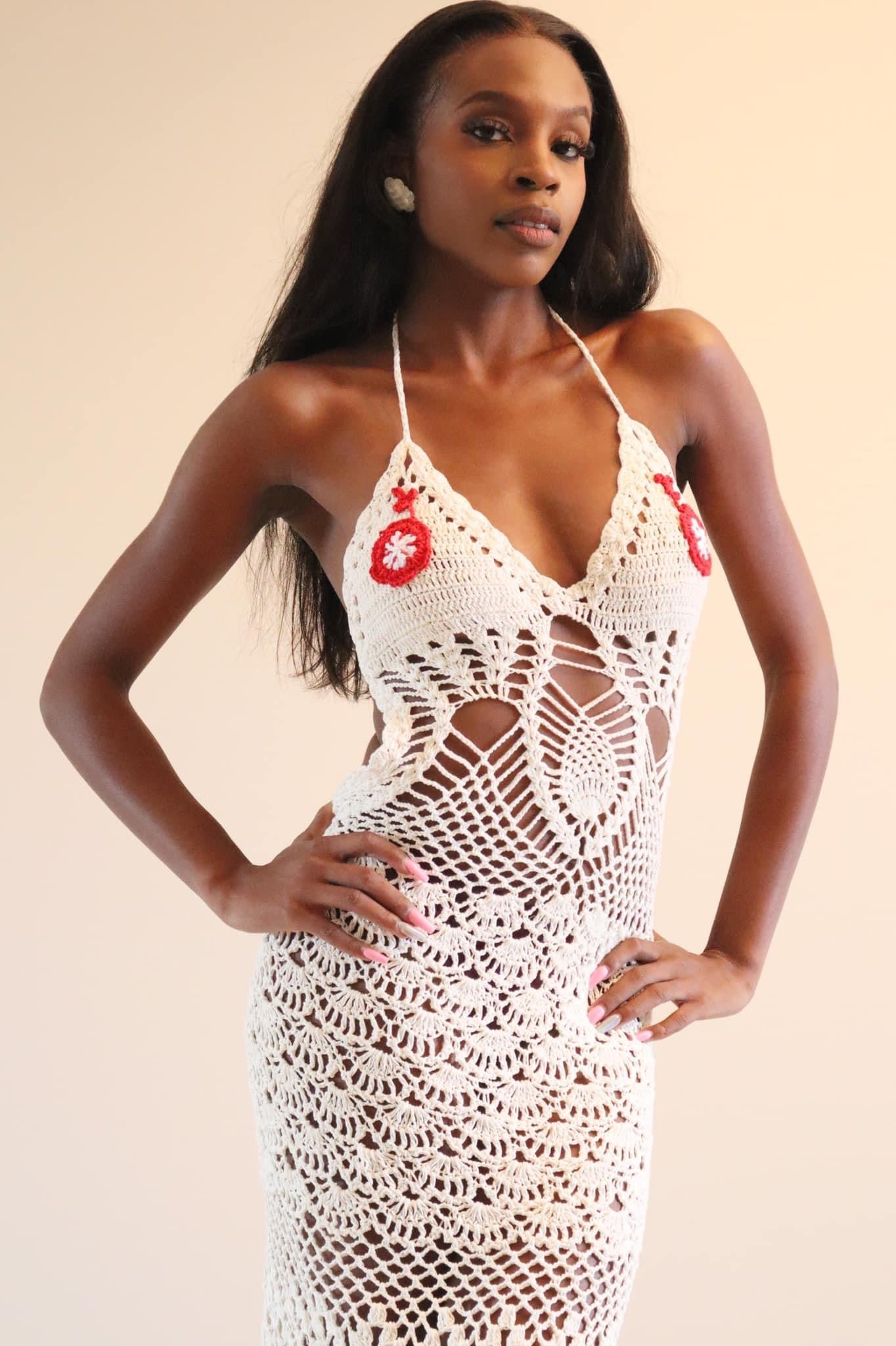
This is where handmade becomes revolutionary. Not in its rarity, but in its regularity. When you wear something made by hands to the grocery store, you're making a statement. You're saying: I value craft over convenience. I choose story over speed. I believe that beauty belongs in the mundane.
Beautiful women never stop wearing handmade because they never stop finding beauty in the everyday. The Tuesday morning. The coffee run. The casual lunch. These moments deserve craft too.
Your Handmade Manifesto
So here's the reframe. Not a shopping list. A philosophy.
- Choose the imperfect. The stitch that's slightly off. The edge that curves. These are signatures, not mistakes. They're proof of humanity in a world of machines.
- Invest in time, not price. A handmade piece that took forty hours to create is worth more than a machine-made piece that took forty minutes, regardless of what the tag says.
- Wear the maker. When you put on handmade, you carry someone's afternoon, someone's patience, someone's skill. That's not clothing. That's connection.
- Reject the disposable. Choose pieces that age, that soften, that tell your story over years. True beauty is longevity.
- Make it yourself. Even if you're a beginner. Even if your first attempt is lumpy. The act of creating what you wear transforms your relationship with your wardrobe from consumption to conversation.
May your wardrobe be slow. May your stitches be even. May your beauty be unmistakably, irreplaceably yours.