This post contains an affiliate link. If you click, you can check out and purchase the👉 Crochet Pattern Plush Granny Square PDF on Creative Fabrica. New users get 10 free downloads."
What if the most complicated thing about crochet isn't the stitches — but the decision to begin?
We've been trained to believe that making things requires permission. A certificate. A course. A grandmother who passed down the secret knowledge on a rainy Sunday while the smell of soup filled the kitchen. We look at a crocheted blanket and see skill, patience, a lifetime of practice. We see the finished object and assume the journey must have been equally complex — months of frustration, tangled yarn, thrown hooks, abandoned projects hidden in shame at the back of a closet.
But here's the plot twist that changes everything: crochet has only one stitch more than tying your shoes.
Everything else — the blankets, the sweaters, the intricate lace that looks like it was made by fairies with engineering degrees — is just that one stitch, repeated, varied, and combined. The magic isn't in the complexity. It's in the accumulation.
And the only thing standing between you and your first finished piece is the belief that you need to be good at this before you start.
The Permission Problem
Let's start with the reversal.
Open any craft store and the crochet aisle looks like a foreign country. Hooks in sizes from 2mm to 20mm, labeled with letters and numbers that don't correspond to anything logical. Yarn weights with names like "worsted," "aran," "fingering" — words that sound like weather reports from 1850. Patterns written in a code of abbreviations: sc, hdc, dc, tr, sl st. It looks like a language. It looks like a club with a password.
And that appearance is the first trap.
Because crochet isn't a language you need to learn before speaking. It's a language you learn by speaking. You don't study grammar. You make a chain. You don't memorize vocabulary. You make a row. And by the time you've made ten rows, you realize you've been fluent all along — you just didn't know the words for what your hands already knew
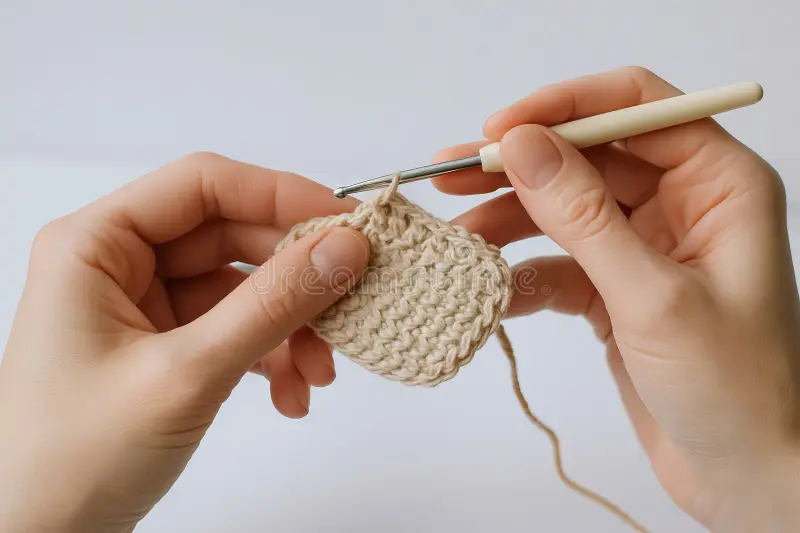
The hands above understand this. They're not expert hands. They're just hands — holding a hook, wrapping yarn, making a circle that will become a coaster, then a square, then a blanket. The grip isn't perfect. The tension wobbles. But the loop is there. And the loop is everything.
Because crochet, at its core, is just pulling one loop through another. That's it. The entire history of textile art — from Victorian doilies to modern chunky throws — rests on that single mechanical action. Your hands already know how to do this. They do it every time they button a coat or tie a knot in a grocery bag.
The hook is just a finger that never gets tired.
What You Actually Need (It's Less Than You Think)
Here's the counterintuitive truth that changes everything: you can start crochet tonight with two objects and zero preparation.
Not ten hooks. Not a pattern book. Not a YouTube tutorial that lasts forty-five minutes and tells you to "relax your shoulders" seventeen times.
Two things:
- One hook (size 5mm, also called H/8 — the middle child of hooks, forgiving and versatile)
- One ball of yarn (medium weight, also called "worsted" or "aran" — pick a color that makes you want to touch it)
That's it. The rest is optional. The stitch markers, the row counters, the fancy ergonomic hooks with rubber grips shaped like flowers — they're lovely. But they're not necessary. They're the equivalent of buying a chef's knife set before you've boiled your first egg.
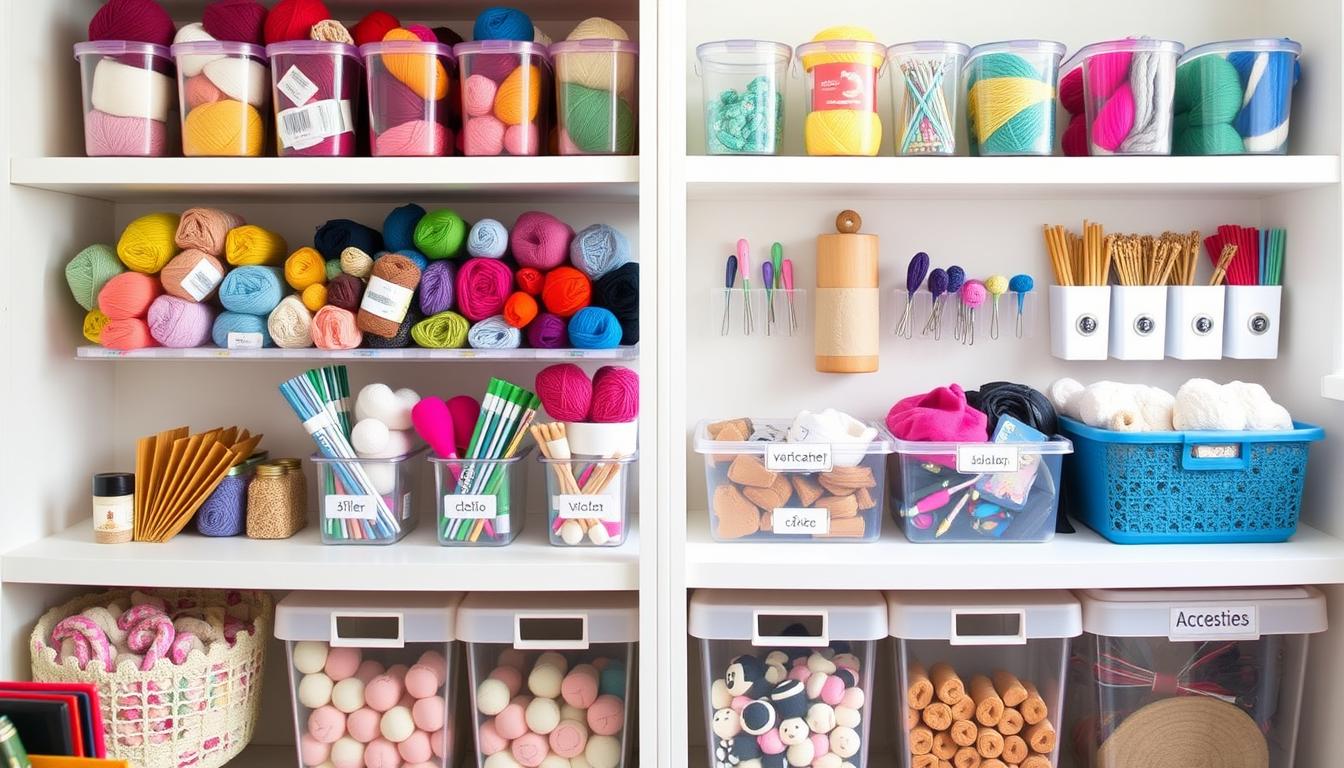
The shelves above show what happens when the bug bites. Hooks in every size. Yarn sorted by color like a painter's palette. But this isn't the starting line. This is the finish line, five years later. The starting line is one hook, one ball, and the courage to make something ugly on purpose.
Because your first piece will be ugly. And that's not a prediction — it's a requirement.
The First Ugly Thing
Let's talk about the first thing you'll make. Not because it's important in itself, but because your relationship with it determines everything that comes after.
It will be a rectangle that isn't rectangular. The edges will curve like a smile or frown depending on whether you accidentally added or dropped stitches. The tension will be uneven — tight where you were concentrating, loose where you got comfortable and started watching Netflix. It will look, to your critical eye, like a mistake.
But to the eye of experience, it looks like a beginning.
That uneven edge is evidence that your hands were learning. The tight sections show where you cared too much. The loose sections show where you relaxed into the rhythm. The whole misshapen object is a map of your first hour with a hook — and maps of first hours are always more interesting than maps of perfect journeys.
Keep it. Don't unravel it. In five years, when you're making sweaters that fit and blankets that lie flat, that first wobbly rectangle will remind you that expertise isn't a destination. It's just the accumulation of wobbly rectangles.
5 Stitches That Build Everything
Ready to learn the actual mechanics? Here are the five stitches that contain the entire universe of crochet. Master these, and you can make anything.
1. The Chain (ch)
The foundation of everything. Yarn over, pull through. Repeat. It looks like a braid. It feels like knitting's simpler cousin. Every project starts here.
2. The Single Crochet (sc)
Insert hook into chain, yarn over, pull through, yarn over, pull through both loops. Two motions. That's it. This stitch is dense, warm, and slow — the meditation stitch.
3. The Half Double Crochet (hdc)
Yarn over, insert hook, yarn over, pull through, yarn over, pull through all three loops. Taller than single, shorter than double. The Goldilocks stitch — just right for blankets and scarves.
4. The Double Crochet (dc)
Yarn over, insert hook, yarn over, pull through, yarn over, pull through two, yarn over, pull through two. Tall, airy, fast. This is the stitch that makes projects grow while you watch.
5. The Slip Stitch (sl st)
Insert hook, yarn over, pull through everything. No height. Just movement. Used for joining, edging, and sneaking across the row when you need to get somewhere else without being noticed.
Table
Table
| Stitch | Height | Speed | Best For |
|---|---|---|---|
| Chain | None | Fast | Foundation, lace |
| Single Crochet | Short | Slow | Amigurumi, dense fabric |
| Half Double | Medium | Medium | Blankets, scarves, everything |
| Double Crochet | Tall | Fast | Shawls, openwork, quick gifts |
| Slip Stitch | None | Fastest | Joining, edging, texture |
This table isn't just reference. It's a roadmap. Start with single crochet. Get comfortable. Then add half double. Then double. Within a week, you'll be combining them without thinking — and that's when crochet stops being craft and starts being conversation.
Your First Real Project
Now look at the image below. This is where you're headed.
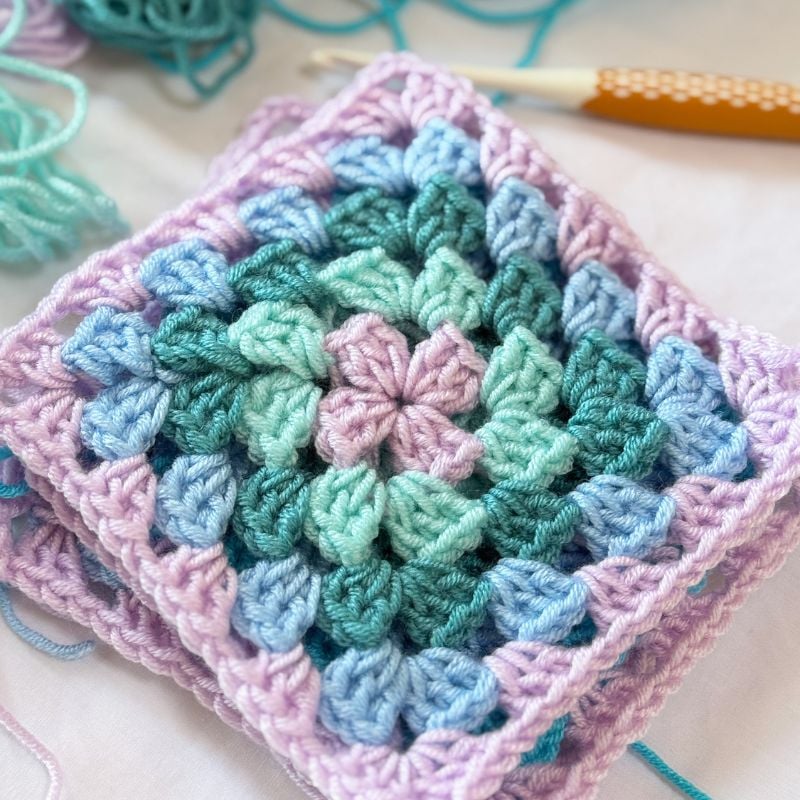
The granny square above is the beginner's graduation ceremony. It's not one stitch — it's all of them, dancing together. Chains form the corners. Double crochets cluster in groups of three. Slip stitches sneak between them, holding everything in place. And the color changes — oh, the color changes — turn a simple square into a stained-glass window.
The granny square is crochet's greatest gift to beginners because it teaches rhythm. You don't count every stitch. You count clusters. You count corners. The pattern repeats like a heartbeat: cluster, chain, cluster, chain, corner. After three rounds, your hands know the dance. Your eyes stop reading the pattern. Your fingers take over.
And then — this is the moment — you realize you've been crocheting for an hour without looking up. Without checking your phone. Without thinking about tomorrow's meeting or yesterday's argument. You've been in a state that neuroscientists call "flow" and grandmothers call "Tuesday."
That's not a hobby. That's therapy with a hook.
The Meditation Nobody Talks About
Here's the secret that crochet pattern books never mention: the finished object is the least important part.
Yes, the blanket is warm. Yes, the scarf keeps your neck cozy. Yes, the baby booties make people cry at baby showers. But the real product — the thing you carry with you when the project is done — is the state of mind that crochet creates.
The repetitive motion of the hook. The slight resistance of yarn against fiber. The predictable rhythm: insert, yarn over, pull through, yarn over, pull through. It's a mantra made physical. And like any mantra, it quiets the part of your brain that generates anxiety.
Studies have shown that repetitive handcrafts lower cortisol levels, reduce rumination, and activate the parasympathetic nervous system — the "rest and digest" mode that modern life has almost eliminated. Crochet doesn't just make things. It makes calm.
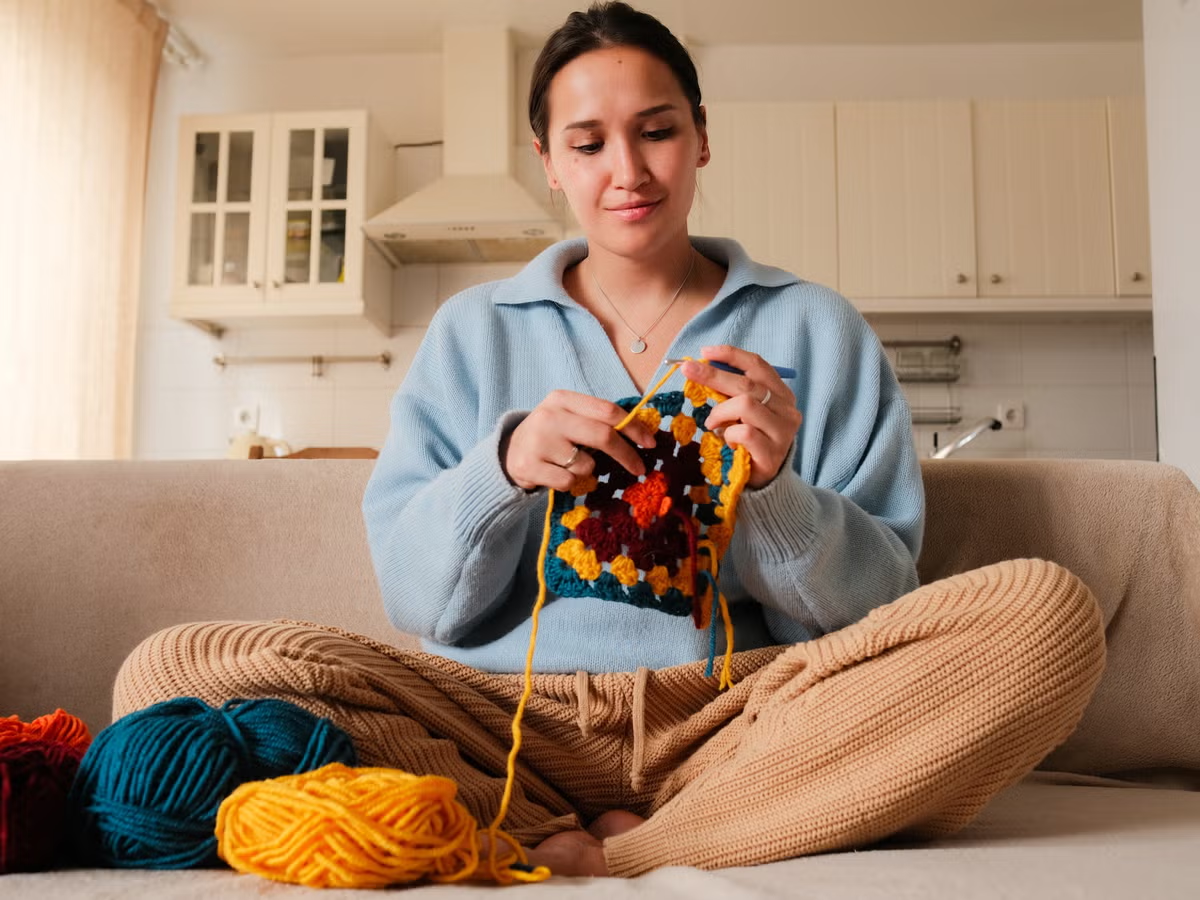
The woman above isn't making a blanket. She's making peace. The sofa is soft. The light is low. The yarn is bright and alive in her hands. She isn't performing productivity. She isn't optimizing her time. She's simply present — loop by loop, breath by breath, minute by minute.
This is why crochet is having a renaissance among people who have never held a hook before. Not because they need another blanket. Because they need another way to be still.
The 30-Day Beginner Roadmap
Ready to start? Here's a realistic path from "I've never held a hook" to "I made this."
Week 1: The Chain and the Rectangle
Make chains. Lots of them. Then practice single crochet back and forth until you have a rectangle that resembles a very small, very ugly dishcloth. Celebrate it.
Week 2: The Granny Square
Learn double crochet. Make a granny square. It will curl at the corners. It will have holes where there shouldn't be holes. Make another. The third one will lie flat. That's your magic number.
Week 3: The Scarf
Chain 25. Half double crochet back and forth until it's long enough to wrap around your neck twice. Use a color you love. Wear it even if the edges wave like a flag.
Week 4: The Blanket Decision
Either make twelve more granny squares and join them, or start a simple blanket in half double crochet. The key decision: do you want a quick win (granny squares) or a long journey (one big piece)? There's no wrong answer.
Month 2: The First Gift
Make something for someone else. A coaster. A washcloth. A simple beanie. The moment you give away something your hands made, crochet stops being a hobby and becomes a language — a way of saying I thought of you without words.
Your Crochet Manifesto
So here's your homework. Not a shopping list. A shift in attention.
Buy one hook and one ball of yarn. Not tomorrow. Not when you "have time." Tonight. On the way home. The yarn should be a color that makes you feel something. The hook should feel comfortable in your hand — not too light, not too heavy.
Make the first ugly thing. Expect it to be uneven. Expect to lose stitches. Expect to Google "why is my crochet getting wider" at 11 p.m. This is the tuition. Everyone pays it.
Protect the rhythm. The evening hour when the house is quiet. The Sunday morning when the coffee is hot. The waiting room where you'd otherwise scroll through news that makes you anxious. These are your crochet hours. Defend them like appointments with a therapist — because functionally, they are.
Give away the first good thing. The scarf. The coaster. The granny square that finally lies flat. Give it to someone who will use it. Watch them hold something your hands made. That feeling — that specific, irreplaceable feeling — is why people crochet for fifty years.
May your chains be loose. May your tension be even. May your first ugly rectangle become your most treasured artifact. And may you discover that the hook doesn't just make blankets — it makes peace, one loop at a time.