What if the best crochet teacher isn't a person — but a page?
We've been trained to believe that learning happens on screens. A YouTube tutorial at 2x speed. A TikTok clip that shows a stitch in fifteen seconds. An Instagram carousel that promises to teach you granny squares between subway stops. The screen is immediate, infinite, and always ready to answer the question how do I do this?
But here's the plot twist that changes everything: the question you actually need answered isn't how. It's why.
And screens are terrible at why.
A video shows you the mechanics. A book gives you the context. A video rushes to the finish. A book lets you stay in the confusion until it becomes clarity. A video is a transaction — you watch, you copy, you move on. A book is a relationship — you return, you annotate, you spill tea on page forty-seven and that stain becomes part of the story.
The best crochet books don't just teach stitches. They teach patience. And patience, unlike a double crochet, is the one skill no algorithm can accelerate.
The Page vs. The Screen
Let's start with the reversal.
Open any streaming platform and search "crochet for beginners." You'll find ten thousand videos. Each one starts with an energetic greeting, a promise of simplicity, and a hook moving so fast your eyes can't track it. You pause. You rewind. You pause again. You try to mimic the motion while holding your phone with your chin. You drop the hook. You drop the phone. You feel old.
The video isn't the problem. The format is.
A screen demands your eyes. Your hands must stop to watch. Then start to copy. Then stop again. The rhythm is broken before it begins. Crochet — which is fundamentally about rhythm, about the meditative repetition of loop through loop — becomes a staccato performance of start-and-stop frustration.
A book demands nothing but your attention. It lies open on the table while both hands work. You glance down, read the next sentence, look back at your hook. The rhythm continues. The page is patient. It doesn't autoplay the next chapter while you're still figuring out the first. It waits.
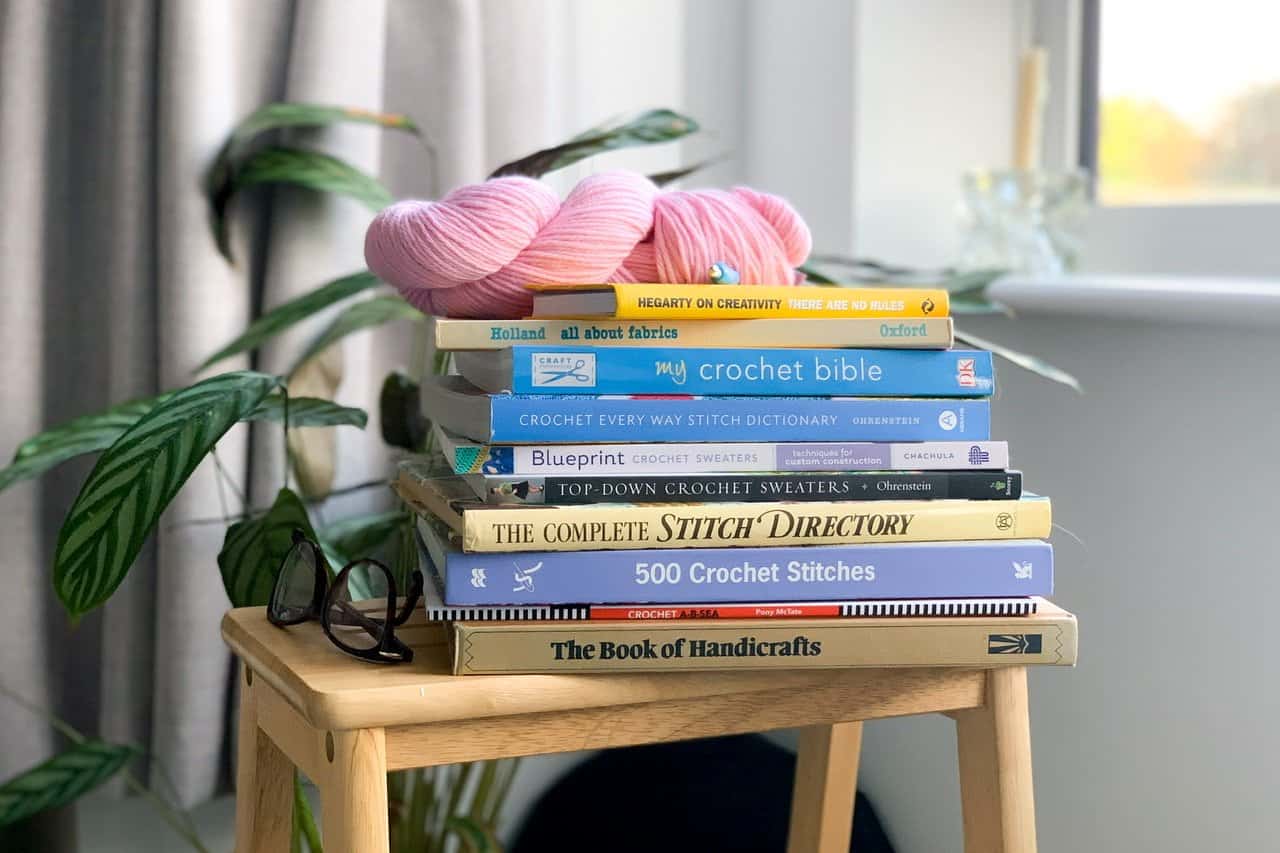
The stack above understands this. Real books with real pages. A ball of pink yarn resting on top like a bookmark. These aren't references you pull up when stuck. They're companions you keep nearby. The spine cracks. The pages soften. The margins fill with your own abbreviations, your own discoveries, your own evidence that you were here.
A crochet book ages with you. A video disappears into the algorithm.
What Makes a Crochet Book Worth Buying
Not every book with "crochet" on the cover deserves shelf space. Here's how to separate the teachers from the tourists.
Clear Photography
Not styled Instagram flat-lays. Close-ups of actual hands holding actual yarn. Photos where you can see the hook entering the loop from the same angle your own eyes see it. If the book shows you a finished blanket but not the stitch that built it, it's a coffee table book, not a manual.
Logical Progression
The best beginner books don't start with a scarf. They start with a chain. Then a row. Then a square. Then a project. Each chapter builds the nervous system of your hands before asking them to perform.
Written Instructions + Charts
Some brains read words. Some brains read symbols. The best books speak both languages. If a pattern only offers written abbreviations, it abandons half its audience.
Troubleshooting Sections
A book that acknowledges mistakes is a book written by a human. "If your edges are wavy, you added stitches." "If your work curls, your tension is too tight." These sentences save hours of unraveling.
Projects That Scale
One simple pattern repeated with variations. A coaster becomes a placemat becomes a blanket. This teaches you that crochet isn't infinite complexity — it's infinite application of the same few ideas.
5 Types of Books Every Beginner Needs
You don't need a library. You need a curriculum. Here are the five books that, together, form a complete education.
1. The Visual Dictionary
This is your foundation. A book that shows every stitch — chain, single crochet, half double, double, treble — in large, clear photographs. No projects yet. Just anatomy. Think of it as the dictionary you consult before writing poetry.
What to look for: Step-by-step photos of hand positions. Explanations of turning chains. A glossary of symbols. This book lives on your table, not your shelf.
2. The First Project Book
One book. Three to five projects. Nothing that requires shaping or decreasing. Dishcloths. Scarves. Simple squares. The goal isn't the finished object — it's the completion. The neurological reward of I made this is more important than the object's beauty.
What to look for: Projects that use only one or two stitches. Clear yarn weight recommendations. Photos of the finished item that look achievable, not aspirational.
3. The Stitch Bible
Once you can chain and double crochet without looking, you need a reference that expands your vocabulary. A stitch bible contains hundreds of patterns — shells, bobbles, ripples, cables — each with a small swatch photo and written instructions.
What to look for: Swatches worked in light-colored yarn so texture is visible. Symbols alongside text. Organization by stitch family, not alphabetical chaos.
4. The Granny Square Bible
Granny squares are the graduate school of beginner crochet. They require joining, color changes, and reading patterns in the round. A book dedicated to this one shape teaches you more than twenty random projects.
What to look for: Classic patterns plus modern variations. Joining techniques. Layout ideas for turning squares into garments, bags, and blankets.
5. The Amigurumi Starter
Amigurumi — small stuffed creatures worked in spirals — teaches tension, counting, and shaping. It's a different nervous system than flat work. A good starter book makes the spiral logical rather than mystifying.
What to look for: Projects that start with simple spheres before adding limbs. Clear instructions for magic ring or chain-start alternatives. Photos of the inside of the piece, not just the cute exterior.
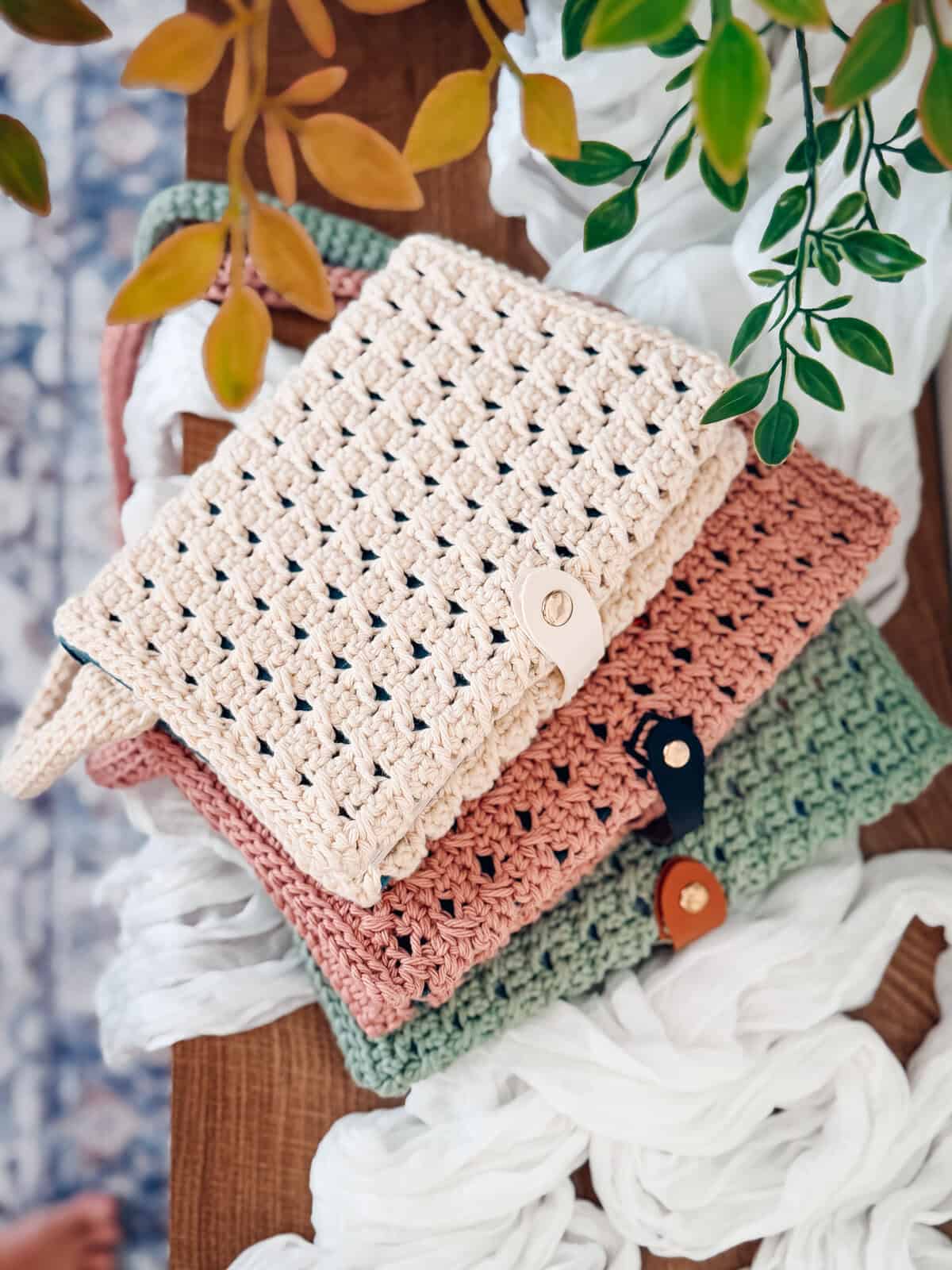
The covers above carry this philosophy. Handmade book sleeves in cream, blush, and sage — each one a crochet project that protects the knowledge inside. This is what happens when the craft becomes the container. The book teaches you. You crochet a cover for it. The loop closes.
The Secret Life of Crochet Books
Here's something nobody tells you: the best crochet book isn't the one you read cover to cover. It's the one you live with.
The page you fold down because it contains the only explanation of front post double crochet that ever made sense. The margin where you wrote "looser here" in pencil. The coffee ring on the granny square chapter. The yarn sample you taped to page thirty-two so you'd remember what "aran weight" feels like.
A crochet book becomes a journal. A record of your learning that no app can replicate.
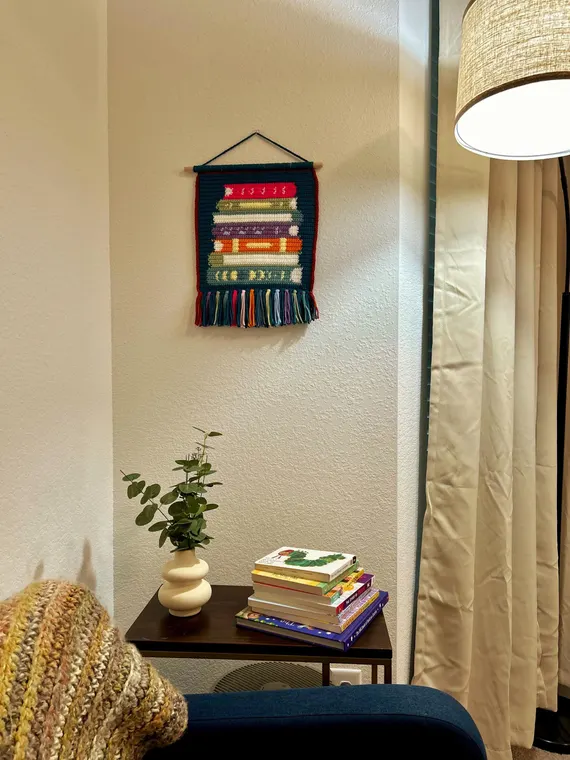
The wall hanging above understands this. A tapestry of stacked books, each spine a different color, each title a different lesson. This isn't just decor. It's a map. Every book on that wall represents an hour of confusion that became clarity. A stitch that felt impossible until it didn't. A project that was abandoned and returned to six months later with new hands.
This is why physical books matter for crochet in a way they don't for other crafts. Knitting can be taught verbally — "knit two, purl two" is a rhythm you can chant. But crochet is visual-spatial. The hook enters from the front, catches the yarn, pulls through two loops while holding three others in suspension. It's a three-dimensional puzzle that flat video compresses into two dimensions.
A book, with its large still photos, preserves the depth. You can stare at a single image for ten minutes without a play button judging you. You can place your own work next to the photo and compare. You can fail in private, at your own pace, with a teacher who never sighs.
Book vs. Screen vs. Class: The Honest Comparison
Table
Table
| Factor | Video Tutorial | In-Person Class | Crochet Book |
|---|---|---|---|
| Pace | Fixed, requires pausing | Group speed, may rush or drag | Entirely yours |
| Angle | One camera angle, often overhead | Instructor's hands, hard to see | Multiple photos, study forever |
| Repetition | Must rewind, loses place | Ask once, maybe twice | Open to page, always there |
| Cost over time | Free or subscription | $30–$100 per session | $15–$30 one time, lasts years |
| Portability | Needs device and signal | Fixed location | Anywhere, no battery |
| Annotation | Comments section chaos | Notes on scrap paper | Margins, highlights, bookmarks |
| Depth | Surface, quick wins | Moderate, social pressure | Deep, builds understanding |
| Community | Anonymous, often toxic | Immediate, supportive | Solitary, introspective |
This table isn't just comparison. It's confession. I've learned from all three. Videos got me started. Classes gave me courage. But books made me fluent. They were the teachers who stayed.
How to Actually Use a Crochet Book
Buying the book isn't the lesson. Using it is. Here's how to build a relationship with your reference that lasts.
Read the introduction. Not the patterns. The intro. The author explains their philosophy, their assumptions, their definition of "beginner." This context prevents the frustration of discovering, twenty pages in, that their "easy" is your "impossible."
Make the first swatch exactly as written. Same yarn weight. Same hook size. Same tension. Don't substitute. The first swatch is a calibration, not a project. It tells you whether your hands match the author's hands.
Keep a "learning swatch" notebook. A three-ring binder with plastic sleeves. Every time you learn a new stitch, make a 4×4 inch swatch, label it with the book title and page number, and slide it in. In six months, you'll have a tactile dictionary you made yourself.
Write in the margins. Circle the stitch count that confused you. Draw an arrow where the pattern turns. Note the date you finished your first project. The book becomes yours when you mark it.
Return to the same book. Don't chase new patterns every week. Finish three projects from one book before buying another. Depth beats breadth. Familiarity breeds confidence.
Your Book Manifesto
So here's your homework. Not a shopping list. A philosophy.
Buy one book before you buy yarn. Not instead of — before. Let the book tell you what yarn to buy. Let the author curate your first experience. Trust their sequence.
Read the first chapter without a hook in your hand. Just read. Understand the language before you speak it. Crochet has a grammar. Learn it.
Make the ugliest swatch in the book. The one that looks like a mistake. The one the author includes to show what not to do. Make it on purpose. See what happens. Understanding failure is faster than avoiding it.
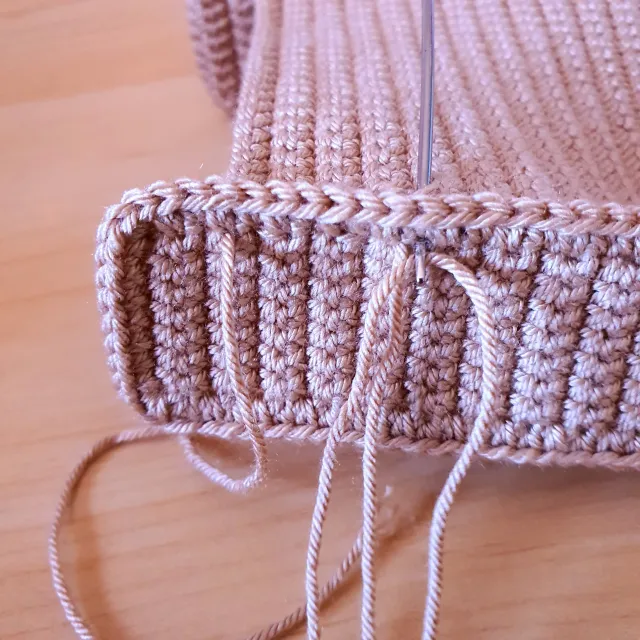
The stitches above carry this philosophy. Close enough to see the tension, the fiber, the exact moment where one loop becomes two. This is the distance a book gives you — intimate, still, patient. The hook waits. The yarn waits. The page waits. And in that waiting, you learn.
Protect the margins. The coffee stains. The pencil notes. The dog-eared page with the stitch that finally clicked. These aren't damages. They're the book's autobiography — and yours.
May your shelves be few and your pages be soft. May your first book become your most worn. And may you discover that the best teacher isn't the one with the most followers — but the one who stays open on your table while you figure it out, loop by loop, hour by hour, in the quiet that only paper allows.