Walk into any Restoration Hardware. The air smells like sandalwood and money. Everything is oversized, underlit, and draped in Belgian linen that costs more per yard than your monthly grocery bill. The sofas are deep enough to lose a small dog in. The tables look like they were carved from trees that witnessed the signing of the Magna Carta.
It's beautiful. It's also a performance.
And here's the plot twist that changes everything: crochet decor can create the exact same emotional effect — the same hush, the same weight, the same sense that someone with impeccable taste lives here — for roughly the price of a single RH throw pillow.
Not cheaper. Not a substitute. The same feeling, achieved through a different door.
The $4,000 Sofa Rule
Let's start with the lie we've all accepted.
We've been trained to believe that luxury lives in price tags. That a living room only feels expensive when the sofa required financing. But the truth is far more interesting: luxury lives in contrast. In the tension between rough and smooth. Between heavy and light. Between the cold geometry of architecture and the warm irregularity of something made by hand.
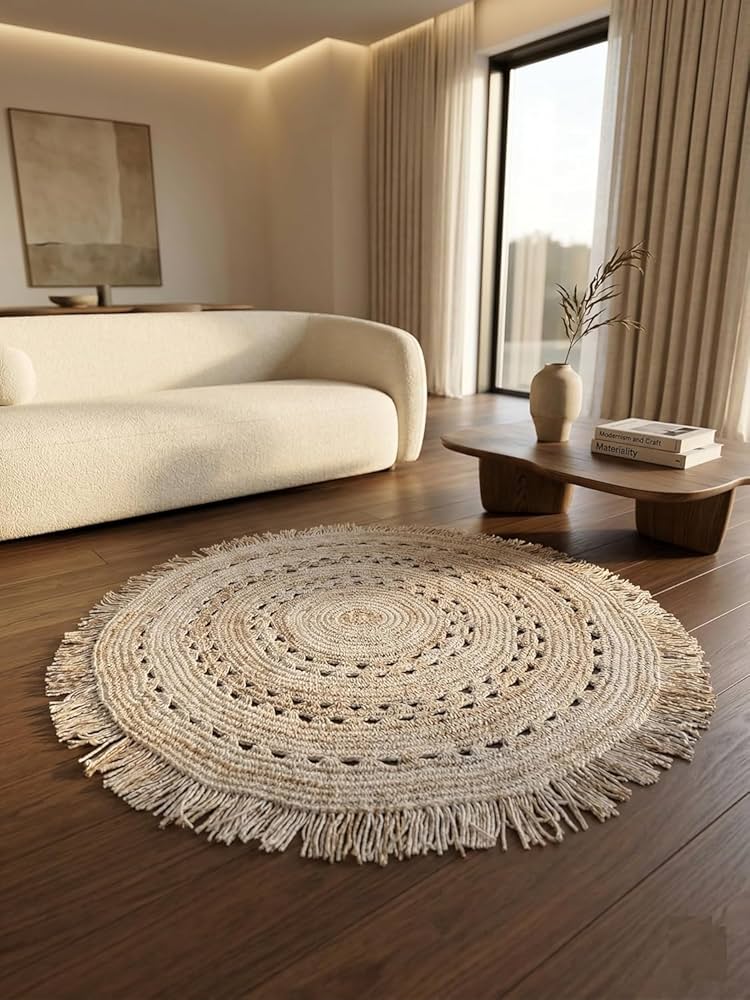
Look at the room below. A curved white sofa that looks like a cloud. Dark wood floors with the kind of grain that suggests old growth. Natural light filtering through linen curtains. And on the floor — a round crochet rug in undyed wool, its spiral pattern radiating from the center like a fingerprint.
The rug didn't cost $4,000. It cost evenings. It cost the decision to use undyed yarn instead of something brighter. It cost the patience to work in a spiral without losing tension. And when your bare feet hit those fibers on a Sunday morning, the sensation is identical to what you'd feel stepping onto a $400-per-square-yard hand-knotted carpet.
Because your nervous system doesn't check receipts. It checks texture.
Restoration Hardware knows this. They sell "vintage" rugs that are artificially distressed to look like they survived a century. But a crochet rug actually carries the memory of its making. The spot where the hook paused. The row that tightened because the phone rang. These aren't imperfections. They're authenticity that money can't manufacture.
Texture as Currency
Here's the counterintuitive truth: in a world of mass production, irregularity has become the ultimate luxury.
Machine-made decor is perfect. Uniform pile. Mathematical symmetry. Colors mixed by algorithms to offend no one and inspire no one. This perfection is impressive for exactly three seconds. Then your brain files it under "background" and moves on.
Crochet does the opposite. It demands attention through its very humanity. The stitch that's slightly tighter than its neighbor. The edge that waves instead of cutting straight. The thickness that varies because human hands tire, pause, adjust.
The blanket above understands this perfectly. Cream wool in a honeycomb stitch, draped over a neutral sofa like it landed there by accident — but landed exactly right. The fringe isn't factory-cut. It's worn. The texture catches afternoon light and turns it into something sculptural. Next to it: a stack of books and a single plant. Nothing else.
This is the Restoration Hardware formula, decoded: one dominant texture + neutral palette + negative space = expensive. They charge $300 for a linen throw that achieves this. You can achieve it with yarn, a hook, and the understanding that luxury isn't bought — it's built, stitch by stitch.
The difference? Their blanket was distressed by a machine in a factory. Yours was distressed by your cat kneading it while you watched Netflix. One comes with a certificate of authenticity. The other is authentic.
5 Ways to Fake a $50K Living Room (Without Faking Anything)
Ready to transform your space without transforming your bank account? Here's the real playbook:
1. Go Monochrome, Not Boring
Choose one neutral and stay in it. Cream, oatmeal, sand, stone. The RH palette isn't about color — it's about the absence of color. A cream crochet blanket on a cream sofa doesn't disappear. It glows. The texture becomes the only language the room needs.
2. Scale Up Without Fear
Small crochet reads "craft fair." Large crochet reads "gallery." A chunky throw in super-bulky yarn. A rug that covers the entire conversation area. Oversized is the secret handshake of expensive spaces.
3. Pair With Cold Materials
Crochet is warm, soft, organic. Place it next to something that isn't: marble, metal, raw wood, glass. The contrast is what makes both elements feel intentional. A crochet basket on a concrete floor. A wool pillow on a leather chair. Tension creates interest.
4. Leave It Imperfect
Don't block your pieces into submission. Let the blanket drape unevenly. Let the pillow sit slightly askew. Restoration Hardware spends millions distressing furniture to look lived-in. Your crochet is already there. Don't iron out the soul.
5. Light It Low
Overhead lighting kills texture. Crochet comes alive in warm, sidelong light — floor lamps, candles, late-afternoon sun. The shadows between stitches become part of the pattern. RH stores are dim for a reason. Mimic the light, mimic the feeling.
The Pillow Test
Now look at the image below and notice what your eye does first.
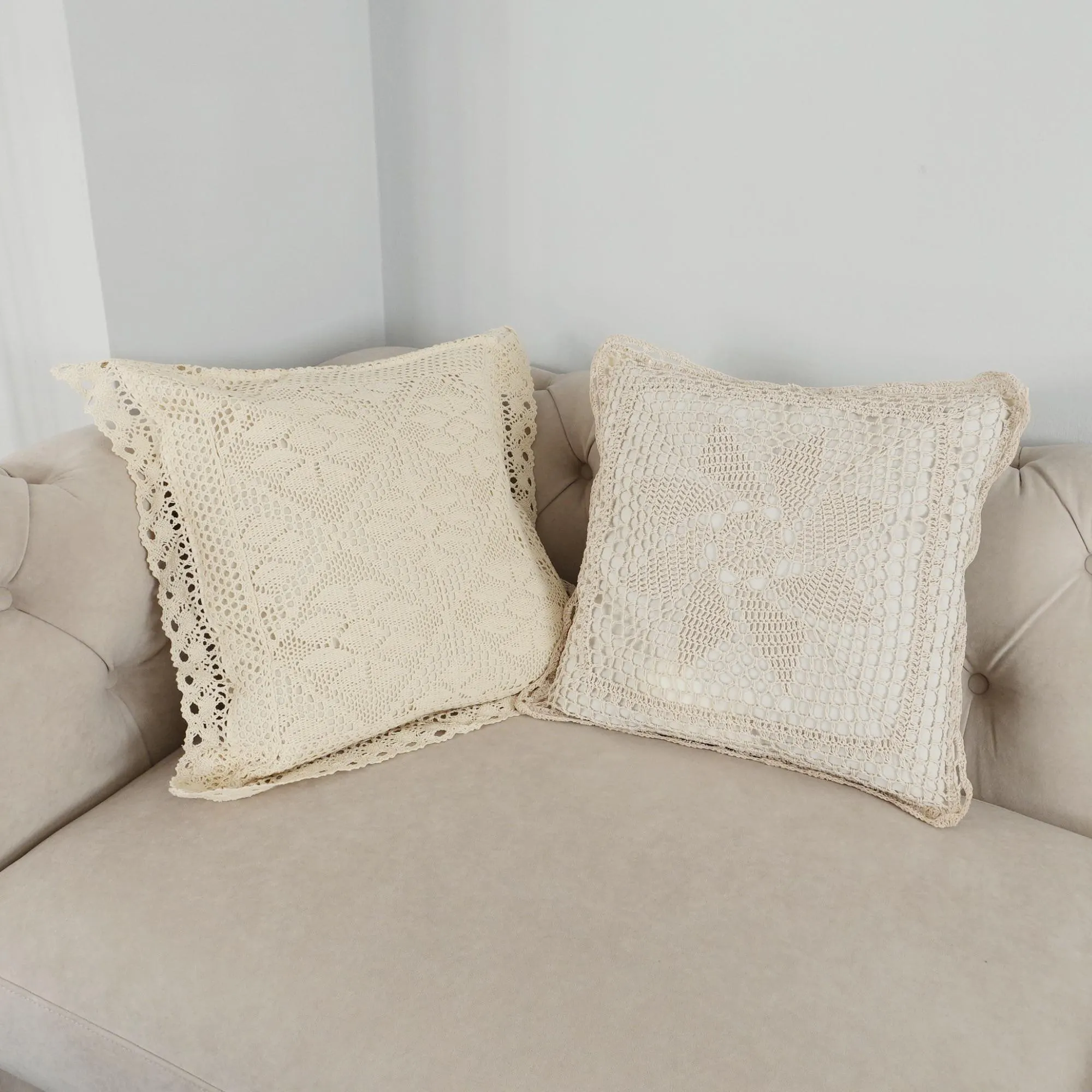
It doesn't go to the sofa. It goes to the pillows. Two cream crochet cushions, side by side, each with a different openwork pattern. One is dense and geometric. The other is lacy and floral. They don't match — they rhyme. And that rhyme is the sound of intention.
A machine would have made them identical. A machine would have optimized for efficiency. But these were made by someone who decided: this pillow will be solid, and this one will breathe. This one will anchor, and this one will whisper.
That decision-making process — visible in the final object — is what separates decor from design. Restoration Hardware hires designers to make these decisions for you. Crochet lets you make them yourself. The result is the same: a room that feels curated rather than purchased.
The Organization Illusion
Here's the final secret, and it's the one that contradicts everything Instagram wants you to believe:
Expensive-looking homes aren't empty. They're contained.
The clutter doesn't disappear. It gets organized into vessels that make it look like art. Open shelves with identical glass jars. Woven baskets that hold the chaos of daily life. Trays that corral the small objects into compositions.
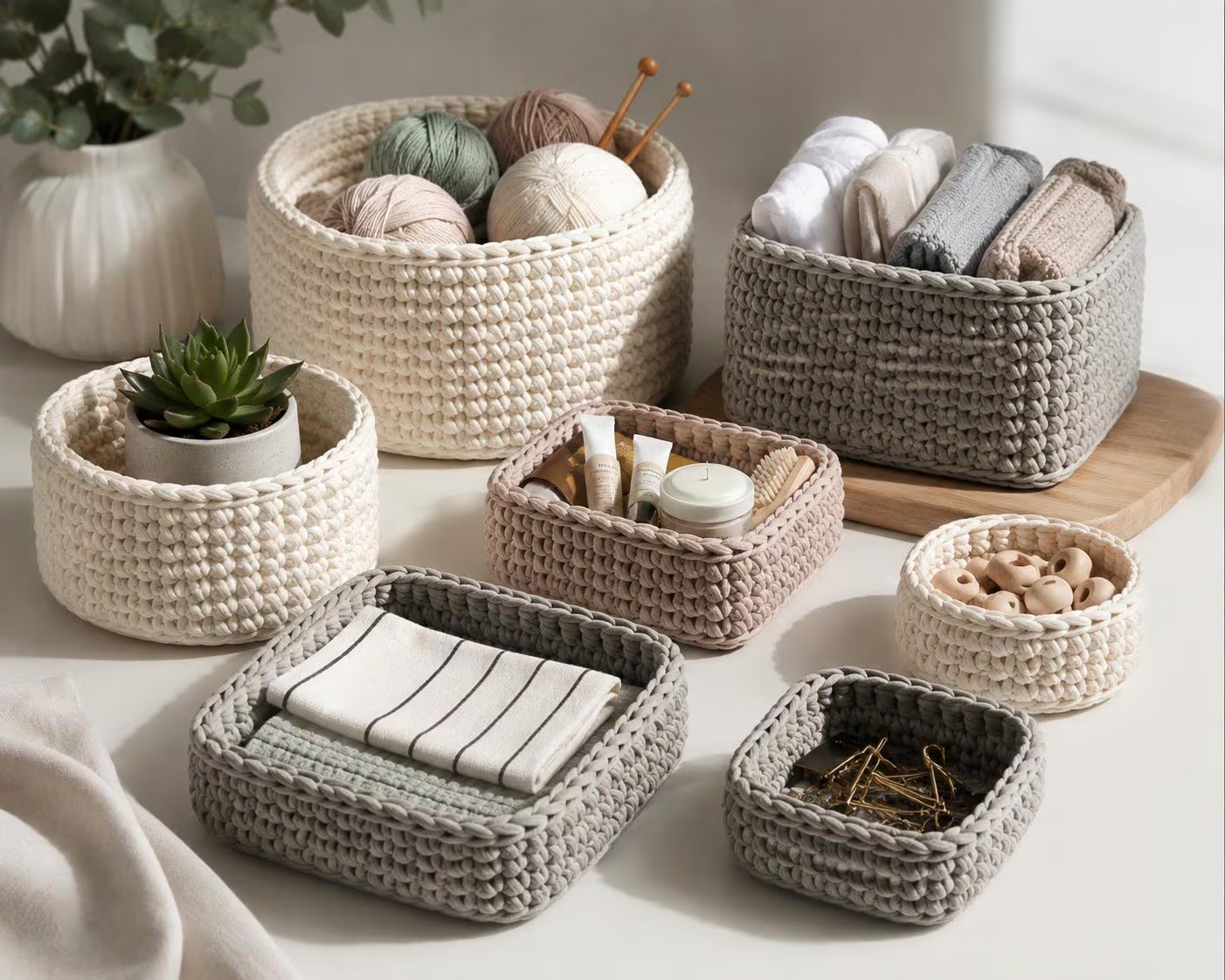
The baskets above carry this philosophy. Chunky crochet in soft neutrals — cream, stone, warm grey. Some hold yarn, some hold towels, one holds a single succulent like a sculpture. They don't hide the mess. They elevate it. The texture of the crochet turns storage into display.
Restoration Hardware sells seagrass baskets for $80 each. These cost the price of cotton yarn and an afternoon of mindless stitching. But the effect is identical: the room looks like someone with restraint lives here. Someone who chooses what to show and what to tuck away. Someone who understands that organization is the highest form of decoration.
The Science of Neutral
Let's get technical for a moment. Because the physics of why this works are fascinating.
A brightly colored room is a shouting match. Red fights with blue. Pattern fights with pattern. The eye has nowhere to rest, so it rests nowhere. The result is visual exhaustion — the same feeling you get from a day in a casino.
A neutral room with handmade texture is a conversation. The eye moves slowly. It lingers. It notices the way light changes a cream blanket from ivory at noon to amber at dusk. It registers the shadow of a crochet basket against a white wall. It finds the slight variation in tone between two undyed yarns.
Table
Table
| Element | Machine-Made Effect | Handmade Crochet Effect |
|---|---|---|
| Visual calm | Uniform, predictable | Slight irregularity engages without overwhelming |
| Light interaction | Consistent reflection | Shadows between stitches create depth |
| Temperature | Synthetic fibers trap heat | Natural wool breathes, regulates |
| Sound | Silent, flat | Textile absorbs echo, softens acoustics |
| Touch | Smooth, sealed | Micro-massage, biophilic response |
This table isn't theory. It's a diagnostic tool. Walk through your home and check: does each room have at least three of these handmade elements? If not, you know where to start.
Your RH Manifesto
So here's the reframe. Not a shopping list. A philosophy.
Restoration Hardware sells the feeling of a life well-lived. But they sell it as a product. You can buy the feeling — or you can make it. And making it doesn't just save money. It changes the frequency of the room.
A crochet rug underfoot reminds you that patience exists. A handwoven blanket on the sofa reminds you that warmth can be built. A basket on the shelf reminds you that chaos, properly contained, becomes beautiful.
Remove one machine-made thing. The synthetic throw that pills. The plastic storage bin. The decorative object that came with a barcode.
Add one handmade thing. Not expensive. Just made. A crochet pillow. A wool basket. A single coaster worked in cotton while you listened to rain.
Protect the imperfection. The slight unevenness of the rim. The spot where the dye didn't take perfectly. The edge that curls no matter how many times you block it. These aren't flaws. They're the evidence that a human was here.
May your home feel like a Restoration Hardware catalog. May your hands be the ones who made it that way.