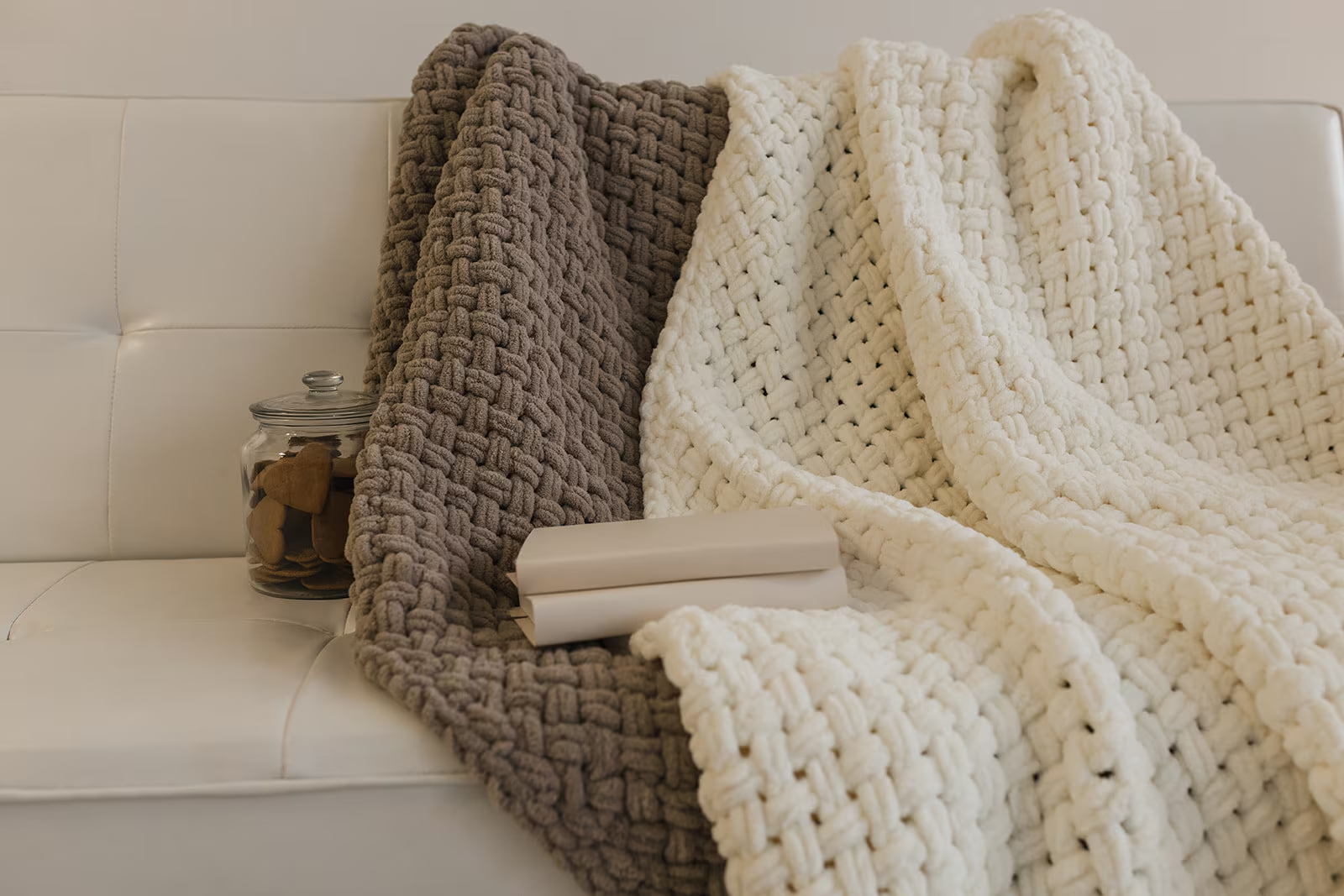
They told us macramé was back. Then quilting. Then embroidery. But crochet never needed a revival — because it never needed saving.
We've been trained to believe that newness is the engine of style. That fashion moves forward by abandoning what came before. That the moment something becomes familiar, it becomes embarrassing — the shag carpet, the macramé owl, the doily under every lamp in your grandmother's house. We look at crochet and see nostalgia. We see the past. We see something that belongs in a museum of domesticity, not in a modern living room.
But here's the plot twist that changes everything: crochet isn't vintage. It's eternal. And eternity, by definition, never goes out of style.
The same loops that warmed a Victorian parlor are warming a Brooklyn loft right now. The same stitches that covered a prairie bed are covering a meditation cushion in Copenhagen. The technique hasn't changed because the technique doesn't need to change. What changes is us — our need, our anxiety, our endless search for the thing that will finally make us feel at home. And crochet, with its quiet, maddening, meditative repetition, is always there at the end of the search, saying: I was here before you were born. I'll be here after you're gone. Sit down.
The Anti-Trend
Let's start with the reversal.
Every other craft has had its boom and bust. Macramé had the seventies and died. Quilting had the nineties revival and faded. Embroidery had its Instagram moment and became background noise again. They all follow the same arc: discovery, explosion, overexposure, exhaustion, irony, obscurity.
Crochet doesn't follow this arc. It doesn't spike. It doesn't crash. It simply persists — like a heartbeat, like breathing, like the making of bread. It was never trendy enough to become untrendy. It was never loud enough to become quiet. It existed in the margins for so long that the margins became the center.
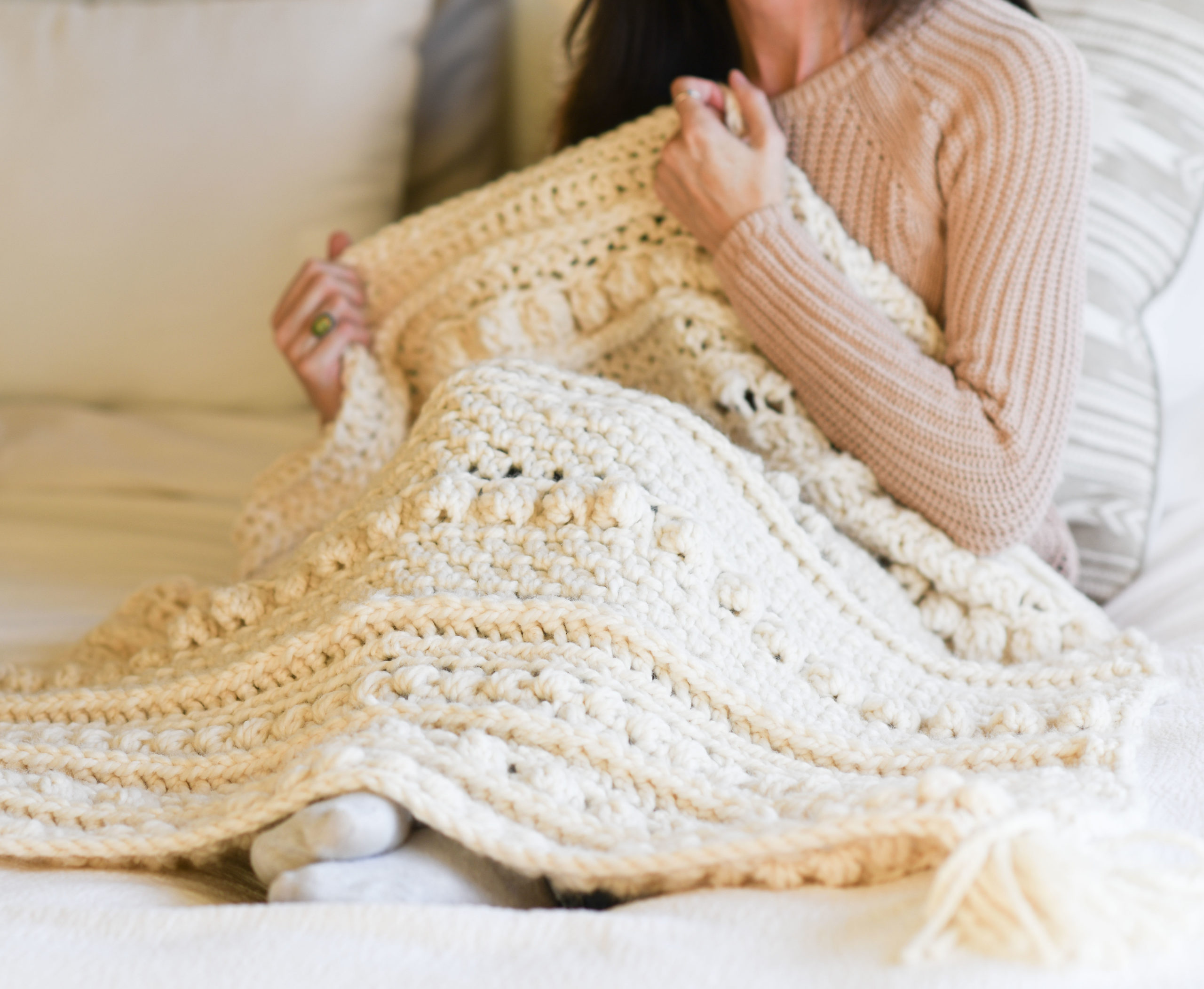
The blanket above carries this persistence in every row. A chunky sampler of textures — bobbles, ribs, shells, clusters — worked in wool that will outlast the hands that made it. This isn't a throwback. This is a throw-forward. The colors are vintage only because vintage is what we call things that have already proven they last.
And that's the secret: crochet doesn't borrow from the past. It lends to the future. Every piece you make today is a loan against a time when someone will need exactly this warmth, exactly this weight, exactly this evidence that a human being cared enough to loop one strand through another ten thousand times.
Why Machines Can't Kill It
Here's the counterintuitive truth: the more advanced technology becomes, the more valuable crochet becomes.
We can 3D-print a chair. We can algorithmically generate a sweater pattern. We can mass-produce a blanket in a factory that never sleeps, never blinks, never pauses to wonder if the tension is right. And we do. We do all of these things, brilliantly, efficiently, cheaply.
But we cannot mass-produce time.
A machine blanket is the product of minutes — fiber in, blanket out, next. A crochet blanket is the product of hours — evenings, commutes, waiting rooms, the pause between one life event and the next. The time is woven into the object. You can feel it. You can weigh it. You can spread it on your bed and know that someone, somewhere, chose to spend forty hours of their finite life making sure your feet would be warm.
The doilies above understand this. Three small circles of cotton, each one a different shade of patience. The hook beside them is worn smooth by use. The stitches are tight where the maker was focused, looser where they relaxed into the rhythm. These aren't factory-perfect. They're human-perfect — which is to say, imperfect, specific, and completely unreplicable.
And in a world where everything is replicable, unreplicability becomes the ultimate luxury. Not the luxury of price. The luxury of proof. Proof that a person was here. Proof that time was spent. Proof that the object in your hands is the only one of its kind in the universe.
The 5 Reasons Crochet Outlives Every Trend
Ready to understand why this craft persists while others fade? Here's the real playbook:
1. It Scales Infinitely
A doily. A blanket. A dress. A rug. A sculpture. A lampshade. A bag. A hat. The same tool, the same motion, the same loop — applied to any scale. Crochet isn't a technique for one thing. It's a technique for everything. And techniques that do everything don't die. They evolve.
2. It Travels Light
One hook. One ball of yarn. That's a craft that fits in a pocket, a purse, a drawer. It doesn't require a studio. It doesn't require a machine. It doesn't require electricity, Wi-Fi, or a subscription. It requires hands, and hands are the one tool every human already owns.
3. It Ages in Reverse
Machine-made textiles fade, pill, and look tired. Crochet blooms. The fibers soften. The texture opens. The drape improves. A crochet blanket in year one is good. In year ten, it's better. In year thirty, it's an heirloom. Very few things in your home improve with age. Crochet is one of them.
4. It Cannot Be Faked
You can photograph crochet. You can describe it. You can watch a tutorial. But you cannot understand it without doing it. The tension lives in the fingers, not the eyes. This creates a barrier to entry that protects the craft from overexposure. Not everyone will crochet. And because not everyone will, those who do possess something rare.
5. It Is the Original Slow Fashion
Before "slow fashion" was a hashtag, crochet was slow fashion. You bought yarn. You made a garment. You wore it for decades. When it tore, you repaired it. When you outgrew it, you unraveled it and made something else. Zero waste. Zero carbon footprint from shipping. Zero exploitation of garment workers. Just fiber, hook, and time.
The Granny Square Is a Time Machine
Now look at the image below and notice what your grandmother and your niece have in common.
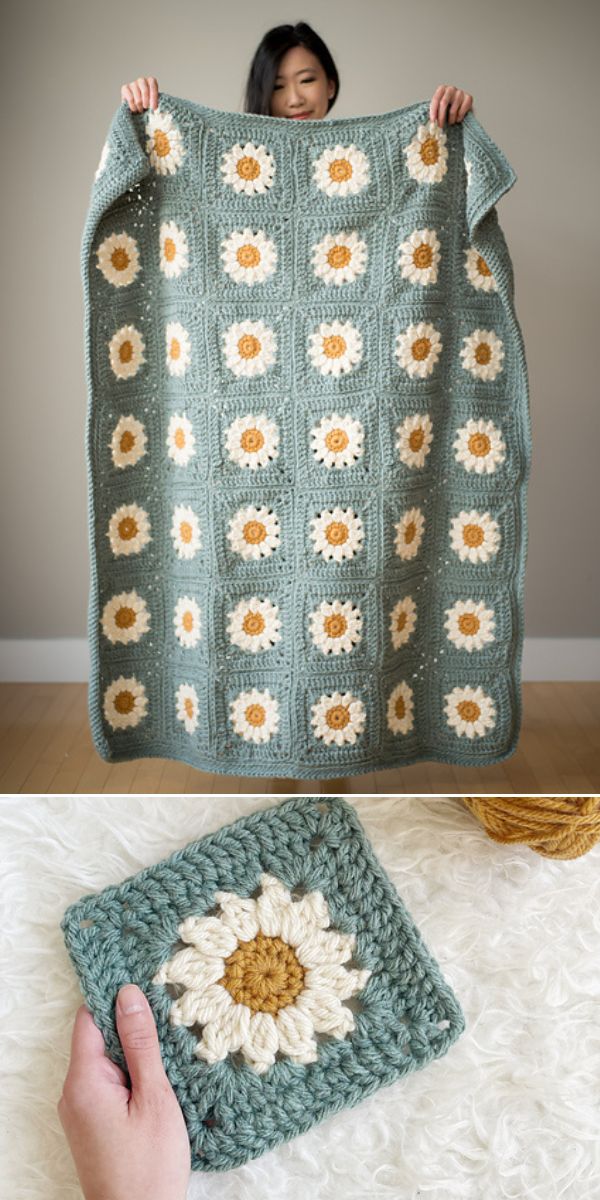
The blanket above is a granny square sampler — daisies in sage and cream, joined into a grid that could cover a bed or a lap. The pattern is older than the internet. Older than television. Probably older than your grandmother's grandmother. And yet a twenty-year-old in Portland is making this exact blanket right now, posting it on TikTok, and receiving thousands of comments asking for the pattern.
This is the time machine effect. Crochet moves through generations not by being preserved in museums, but by being recreated in living rooms. The granny square doesn't survive because someone saved it. It survives because someone made it again. And again. And again. Each repetition is a vote for its continued existence.
The pattern is free. The technique is known. The only thing required is the decision to start. And that decision — made by millions of hands across centuries — is what keeps crochet alive. Not a corporation. Not a trend forecaster. Just the quiet, stubborn, human refusal to stop making things with our hands.
The Science of the Loop
Why does this specific craft persist when others don't? Because the loop is perfect.
Not aesthetically perfect. Mechanically perfect. A crochet stitch is a knot that can be tightened or loosened, joined or separated, worked in a line or in the round. It's the DNA of textiles — simple, repetitive, capable of infinite variation.
Table
Table
| Element | Machine Knit | Hand Crochet |
|---|---|---|
| Structure | Interlocking loops, uniform | Interlocking loops, variable |
| Stretch | Predictable, mechanical | Organic, responsive |
| Repair | Difficult, often impossible | Easy, part of the design |
| Weight | Light, efficient | Heavy, grounding |
| Texture | Flat, sealed | Dimensional, open |
| Emotional effect | Functional | Therapeutic |
| Lifespan | 5–10 years | 30–100+ years |
This table isn't just comparison. It's a diagnosis. If your home is full of things that are efficient but dead, crochet is the antidote. It brings in weight, texture, time, and the irregularity that tells your nervous system: a human made this. You are safe here.
The Modern Proof
Crochet isn't surviving in spite of modernity. It's thriving because of it.
In an age of screens, crochet is tactile. In an age of speed, crochet is slow. In an age of sameness, crochet is unique. In an age of disposal, crochet is permanent. Every anxiety of modern life has a crochet-shaped answer.
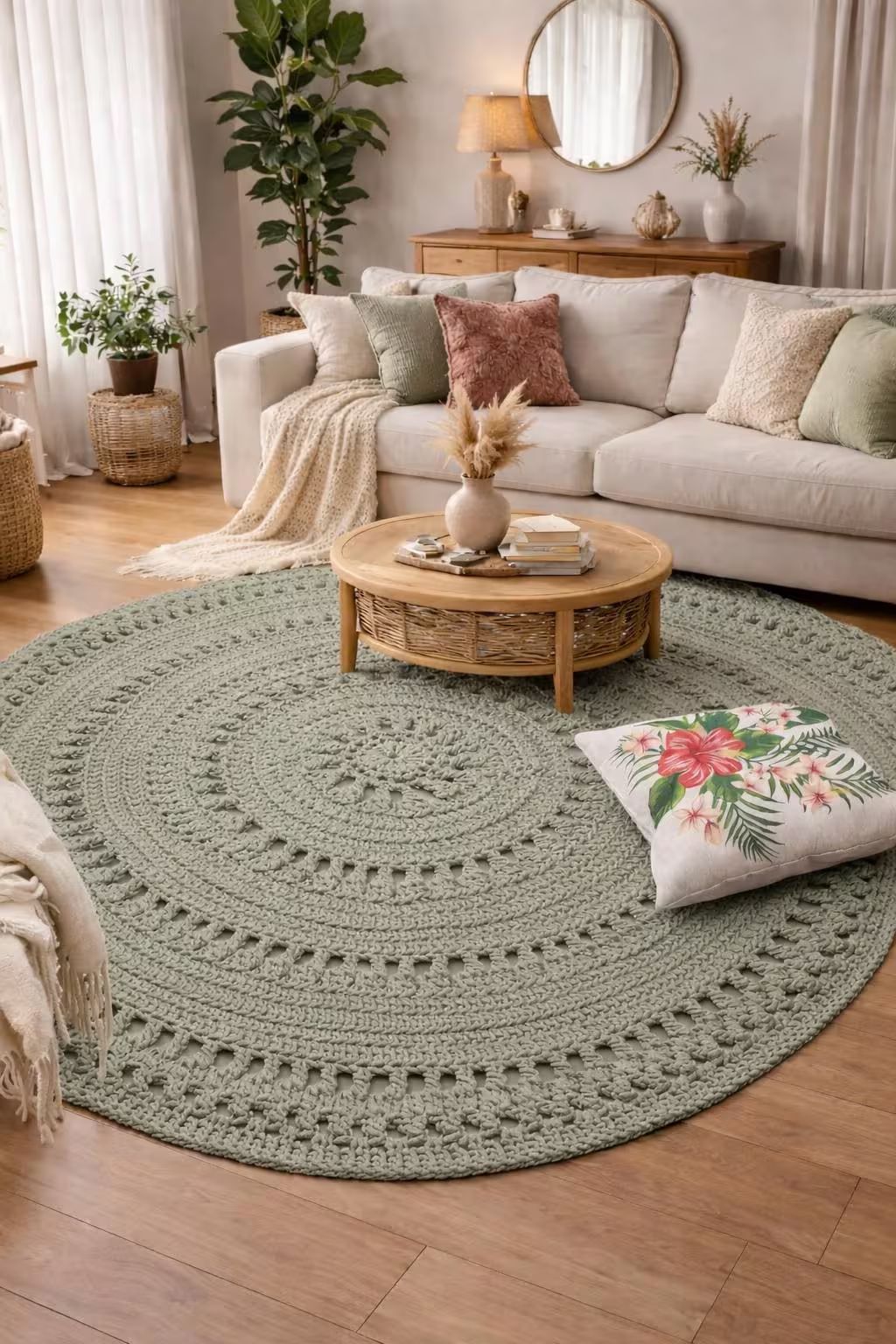
The rug above proves it. A round crochet rug in muted sage, placed in a living room that could be in any city in the world. The furniture is modern. The plant is trendy. The light is Instagrammable. But the rug is ancient technology — looped, joined, shaped by hand — and it anchors the entire room. Without it, the space is a catalog. With it, the space is a home.
This is why interior designers are specifying handmade crochet for luxury projects. Not as an accent. As a foundation. The client doesn't know why the room feels warmer. They just know that it does. And the designer knows that the warmth comes from time, from irregularity, from the evidence of human patience.
Your Crochet Manifesto
So here's your homework. Not a shopping list. A philosophy.
Buy one hook and one ball of yarn. Not because you need another hobby. Because you need proof that your hands can still make something permanent. In a world where everything you create on a screen can be deleted with a keystroke, crochet is undeletable.
Make one ugly thing. The first piece will be uneven. The edges will wave. The tension will be a confession of your distraction. Keep it. In five years, it will remind you that expertise is just the accumulation of ugly things.
Give away the first good thing. The scarf. The washcloth. The granny square that finally lies flat. When someone wraps your work around their shoulders, you understand why this craft never died. Because warmth, once given, creates an obligation to continue.
Protect the handmade. The blanket with the loose thread. The doily with the stain. The rug with the spot where the dog sleeps. These aren't damages. They're biographies. And biographies are always more interesting than perfection.
May your loops be even. May your tension be true. May your home be full of things that outlast you — starting with the ones you make yourself.