There is a moment, usually in the middle of a crowded café, when someone stops mid-sip and asks: "Where did you buy that?" And you say, "I made it." And their face rearranges itself into a geometry of disbelief. Because the thing on your shoulders does not look like a craft project. It looks like it walked off a runway in Milan, took a detour through a Brooklyn atelier, and decided to live on your body.
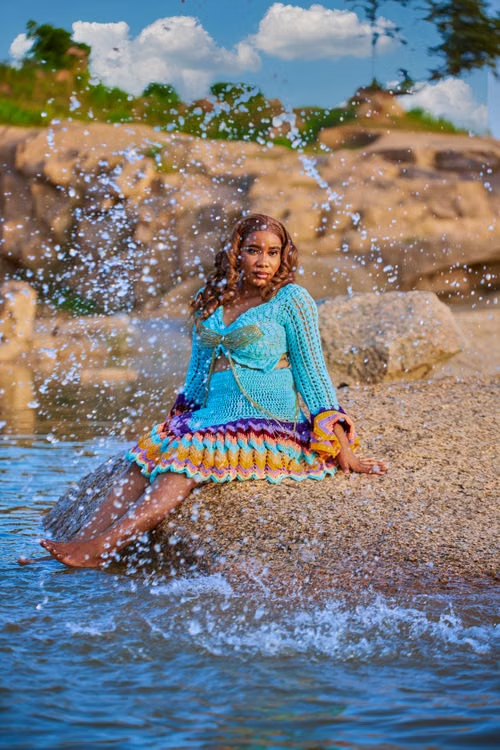
What if the most expensive-looking piece in your wardrobe is the one you create with your own hands?
For decades, crochet has been trapped in a reputation of doilies and baby blankets. But in 2026, the fashion houses have spoken: crochet is haute couture. The difference between a crochet piece that looks like a $2,000 designer original and one that looks like a weekend hobby is not talent. It is a handful of deliberate choices about yarn, tension, hardware, and silhouette.
Below are five crochet projects that can pass for designer fashion — with the exact materials, stitches, and finishing tricks that elevate them from handmade to haute.
1. The Crochet Dress: From Beach Cover-Up to Runway Statement
The crochet dress is the ultimate flex. It says: I have the patience of a saint and the confidence of a supermodel. But only if you avoid the mistakes that scream "I learned this from a 1970s pamphlet."
What makes it look designer:
- Yarn choice: Use cotton-lycra blend or merino-silk fingering weight. The lycra gives the dress structure and recovery; silk adds a subtle sheen that catches light like liquid. Avoid 100% acrylic — it pills, it shines in the wrong way, and it hangs like a shower curtain.
- Gauge: Tight. A designer crochet dress is not lacy or holey. The fabric should have the density of a fine knit. Use a hook 0.5 mm smaller than the yarn label suggests.
- Lining: Yes. Always. A cotton voile or silk charmeuse lining transforms a see-through beach cover-up into a cocktail dress. Sew it in by hand at the neckline and armholes only — the body of the lining should float freely.
- Finishing: Add boning at the side seams (thin plastic boning, hand-sewn into the lining) to give the bodice structure. This one detail separates "cute handmade" from "who is your pattern maker?"
Best beginner-friendly designer silhouette: A midi-length slip dress with a square neckline and spaghetti straps. Simple shapes read as expensive.
Yarn recommendation: Knit Picks Gloss Fingering (70% merino, 30% silk) or Debbie Bliss Rialto Lace.
Budget: $40–$80 in yarn + $15 lining = less than a fast-fashion dress, but looks like The Row.
2. The Oversized Cardigan: The "I Borrowed This From a Gallery Owner" Look
The chunky crochet cardigan is having a moment that refuses to end. But the difference between a designer version and a craft-fair version comes down to one word: proportions.
What makes it look designer:
- The sleeve: It must be balloon or bishop-style. A straight sleeve in chunky crochet looks like a tube. A gathered sleeve that narrows at the wrist looks like architecture. Work increases at the elbow and decrease sharply toward the cuff.
- The stitch: Do not use double crochet for the whole thing. Mix front-post and back-post stitches to create ribbed texture, or use the granite stitch (single crochet + chain-1) for a woven, fabric-like surface. The more the crochet mimics woven cloth, the more expensive it looks.
- The closure: Skip buttons. Use one oversized vintage toggle, a leather tie, or leave it open with a giant safety pin at the collarbone. Asymmetrical closures read as editorial.
- The edge: Add a 1-inch i-cord border or a crab stitch (reverse single crochet) edge in a contrasting color. It frames the piece like a painting.
Yarn recommendation: Wool and the Gang Crazy Sexy Wool, or Lion Brand Thick & Quick in a neutral (oatmeal, charcoal, camel).
Pro tip: Work the body in one piece (no side seams) for a fluid drape. Seams in chunky yarn create bulky ridges that break the line.
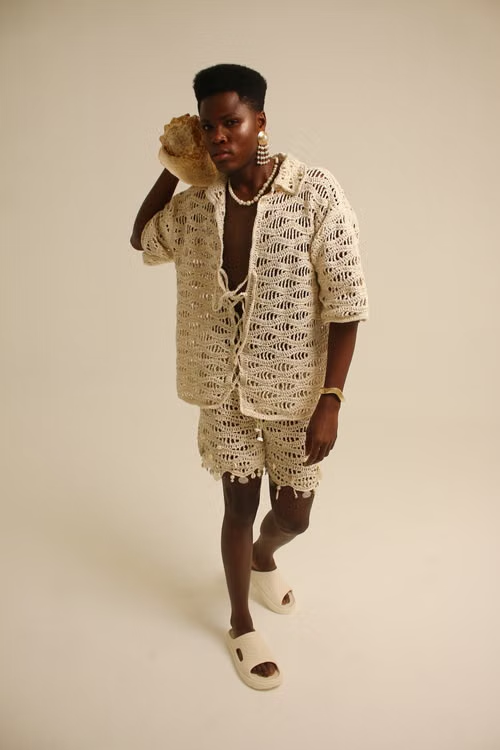
3. The Structured Bag: Where Crochet Meets Hardware
A crochet bag is the fastest route to "designer" status because accessories are judged by their details. A dress can hide a multitude of sins. A bag cannot.
What makes it look designer:
- The body: Use tape yarn (flat, woven ribbon-like yarn) or t-shirt yarn for structure. These yarns do not stretch, so the bag holds its shape. Work in single crochet through the back loop only for a ribbed, leather-like texture.
- The hardware: This is where you spend money. Buy a gold or brass chain strap, leather handles with metal clasps, or a vintage kiss-lock frame. The contrast between soft yarn and cold metal is what makes luxury brands charge $3,000 for a woven bag.
- The lining: Use canvas or faux suede with interior pockets. A bag without lining is a produce sack. A bag with lining and pockets is a handbag.
- The closure: Magnetic snaps are fine for casual bags. For designer energy, use a frame closure (the metal kind that snaps shut) or a drawstring leather cord.
Best shapes for beginners:
- Half-moon clutch with a kiss-lock frame
- Boxy crossbody with a chain strap and leather bottom
- Market tote with leather handles and a reinforced base
Yarn recommendation: Hoooked Zpagetti (t-shirt yarn) or Wool and the Gang Shiny Happy Cotton.
Budget: $20–$40 in yarn + $15–$30 in hardware = a bag that looks like it came from a Milan boutique.
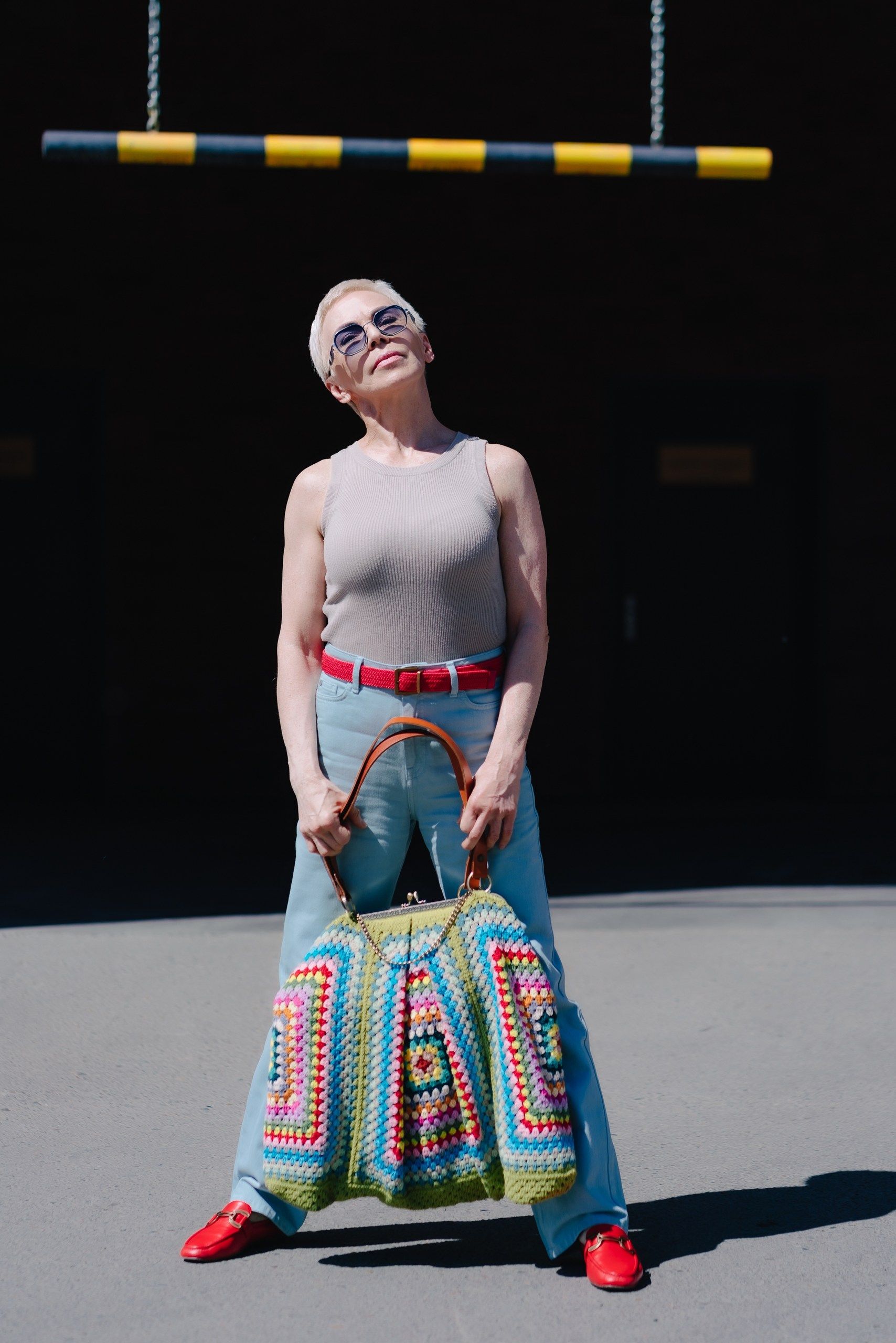
4. The Mesh Market Bag: Elevated Minimalism
The paradox of the designer mesh bag is that it looks effortless while being meticulously constructed. Think: The Row, Jil Sander, Phoebe Philo-era Céline. A single color. No embellishment. Perfect tension.
What makes it look designer:
- The yarn: Use organic cotton cord (3–5 mm diameter) in a single, muted tone — ecru, slate, olive, or black. The cord should be smooth, not fuzzy. Fuzz is the enemy of minimalism.
- The stitch: A simple chain-5 mesh (chain 5, skip 3, single crochet in next) is all you need. The magic is in the tension. Every mesh diamond must be identical. Block the finished bag aggressively — soak, pin, and steam until the geometry is ruthless.
- The handles: Leather. Always. Cut two strips of vegetable-tanned leather (2.5 cm wide, 60 cm long), punch holes, and attach with brass rivets. Sewn-on yarn handles sag and scream "homemade."
- The base: Crochet a solid single-crochet oval base (not mesh) so your keys and phone do not escape.
Yarn recommendation: Bobbiny 3mm Macramé Cord or Ganxxet 5mm Cotton Rope.
Styling tip: Fill it with one perfect thing — a paperback, a bottle of wine, a single sunflower. The bag is the statement. Do not compete with it.
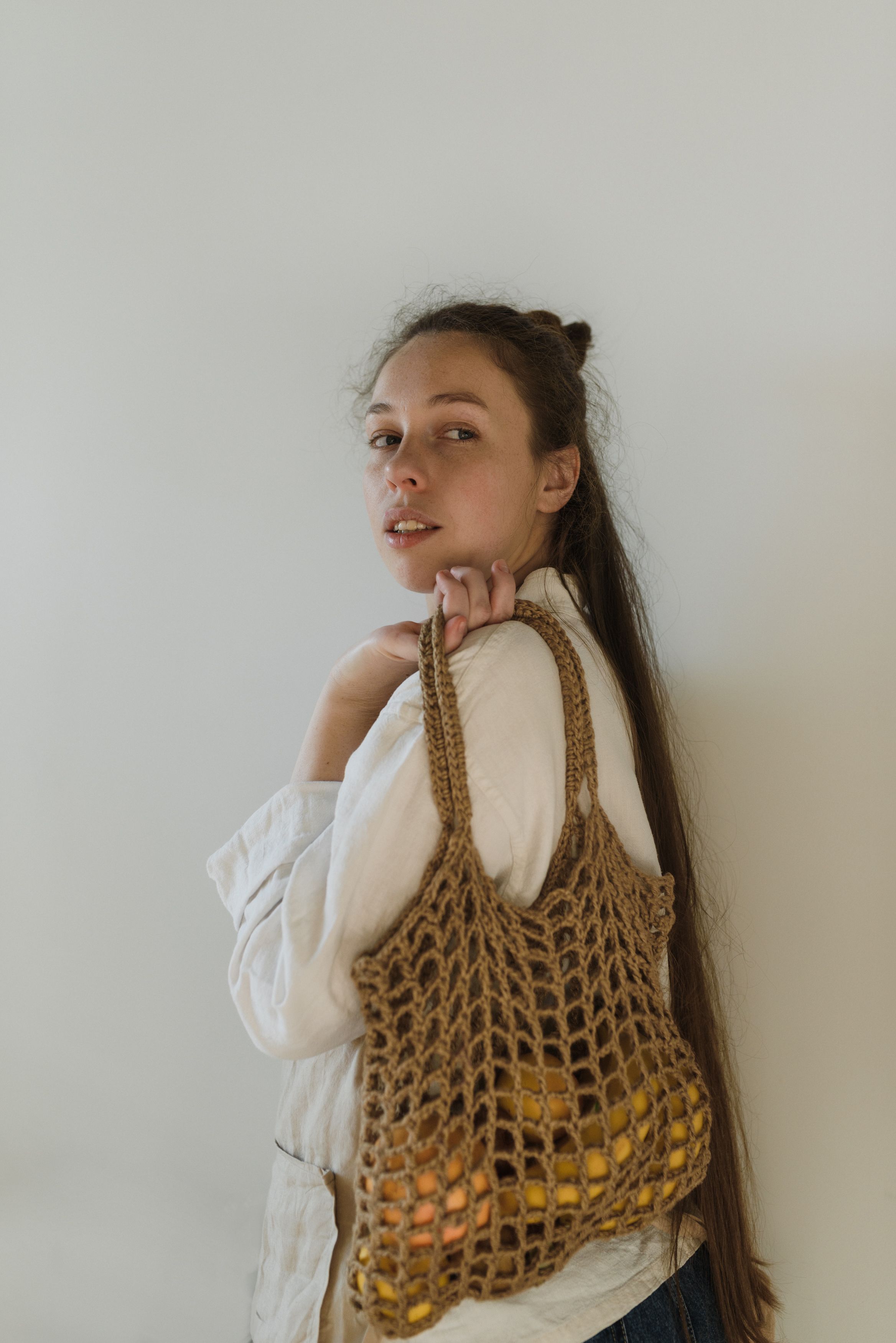
5. The Sculptural Top: When Crochet Becomes Armor
The most avant-garde crochet pieces are not garments. They are sculptures you wear. Think: JW Anderson's chunky chains, Bottega Veneta's woven leather, Paco Rabanne's metal discs. Crochet can mimic all of this — if you think in three dimensions.
What makes it look designer:
- The yarn: Use raffia (natural or paper-based) or hemp cord. These materials hold their shape and create architectural silhouettes that wool cannot achieve.
- The technique: Tunisian crochet creates a dense, woven fabric that looks like basketry. Broomstick lace creates open, laddered strips that look like chain mail. Overlay crochet builds raised geometric patterns that cast shadows.
- The silhouette: Cropped. Boxy. Asymmetrical. A Tunisian crochet crop top with a high neck and cap sleeves looks like it belongs in a museum. A broomstick-lace tank with a low back and thick straps looks like vacation in Capri.
- The finishing: No edging. Let the raw last row show. In high fashion, raw edges signal confidence and intention.
Yarn recommendation: Wool and the Gang Ra-Ra Raffia, or Lang Yarns Lino (linen-cotton blend).
Skill level: Intermediate. These techniques require focus, but the result is unmistakably editorial.
Quick Reference: Yarns That Read as Luxury
Table
| Project | Yarn Type | Fiber Blend | Why It Works | Brand Examples |
|---|---|---|---|---|
| Dress | Fingering / Sport | Merino-silk, cotton-lycra | Drape, sheen, structure | Knit Picks Gloss, Debbie Bliss Rialto |
| Cardigan | Bulky / Super-bulky | Merino, alpaca, wool blend | Weight, texture, warmth | Wool and the Gang, Lion Brand |
| Structured bag | Tape / T-shirt yarn | Recycled cotton, jersey | Body, no stretch, modern | Hoooked Zpagetti, Wool and the Gang |
| Mesh bag | Macramé cord | Organic cotton | Clean lines, minimal fuzz | Bobbiny, Ganxxet |
| Sculptural top | Raffia / Linen | Paper raffia, linen-cotton | Rigidity, shadow, art | Wool and the Gang Ra-Ra Raffia |
The Finishing Secrets No One Tells You
- Block everything. Wet block, steam block, or spray block. Crochet relaxes and evens out after blocking. Unblocked crochet looks handmade. Blocked crochet looks manufactured-by-artisans.
- Weave in ends with a needle, not a hook. Invisible ends are the mark of a professional.
- Add a label. Sew a small leather or fabric label with your initials or brand name into the neckline or bag lining. It costs $0.50 and multiplies the perceived value by ten.
- Photograph it well. Lay the piece on a white linen sheet in natural light. Or wear it with jeans and gold jewelry. Context is everything.
Block everything. Wet block, steam block, or spray block. Crochet relaxes and evens out after blocking. Unblocked crochet looks handmade. Blocked crochet looks manufactured-by-artisans.
Weave in ends with a needle, not a hook. Invisible ends are the mark of a professional.
Add a label. Sew a small leather or fabric label with your initials or brand name into the neckline or bag lining. It costs $0.50 and multiplies the perceived value by ten.
Photograph it well. Lay the piece on a white linen sheet in natural light. Or wear it with jeans and gold jewelry. Context is everything.
The Final Thread
- Designer fashion is not about price tags. It is about intention. The slow choice of a fiber that feels like water. The patience to block a garment until it behaves. The courage to wear something that took forty hours to make in a world that throws clothes away after three washes.A crochet piece that looks like designer fashion is not an illusion. It is evidence. Evidence that you valued your own time enough to spend it slowly. Evidence that you understood that luxury is not bought. It is built. One stitch at a time.
Designer fashion is not about price tags. It is about intention. The slow choice of a fiber that feels like water. The patience to block a garment until it behaves. The courage to wear something that took forty hours to make in a world that throws clothes away after three washes.
A crochet piece that looks like designer fashion is not an illusion. It is evidence. Evidence that you valued your own time enough to spend it slowly. Evidence that you understood that luxury is not bought. It is built. One stitch at a time.