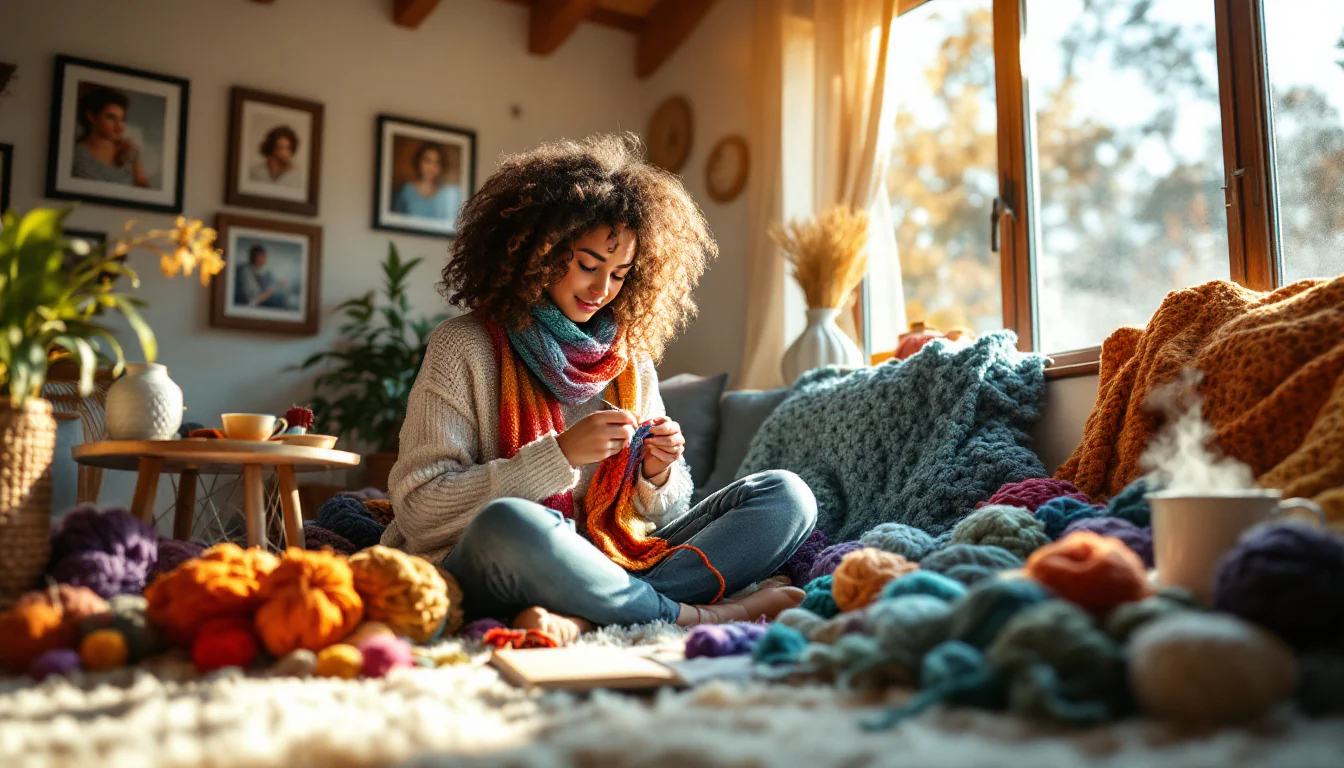
Your mother did it. Your grandmother did it. And now you do it at 3 a.m. while the world sleeps. What if crochet isn't something you outgrow — but something you grow into?
We've been trained to believe that hobbies have an expiration date. That the things we love at twenty are meant to be abandoned by forty. That crochet, specifically, belongs to a phase — a youthful craft phase, a new-mother nesting phase, a retirement phase — and that mature women are supposed to move on to something more sophisticated. Wine tasting. Yoga. Minimalist watercolor painting that requires only three brushes and a sense of superiority.
But here's the plot twist that changes everything: the women who never outgrow crochet aren't stuck. They're rooted.
And roots, unlike trends, don't rotate.
The Age Myth
Let's start with the lie.
Open any craft magazine and you'll find crochet divided by decade. "Fun projects for teens!" "Stylish patterns for your twenties!" "Cozy makes for new moms!" And then — silence. A void where women between forty and seventy are supposed to disappear into gardening or book clubs or whatever society decides is age-appropriate for hands that used to hold hooks.
But the truth is far more interesting. The women who keep crocheting into their forties, fifties, sixties, and beyond aren't clinging to a youthful hobby. They've discovered something that the culture hasn't caught up with yet: crochet gets better with age the same way wine does. The first twenty years teach you the mechanics. Every year after that teaches you the meaning.
At twenty, you crochet for product. At forty, you crochet for process. At sixty, you crochet for peace. And peace, unlike a finished scarf, never goes out of style.
Why the Hook Stays
Here's the counterintuitive truth: the women who never outgrow crochet aren't defined by the craft. The craft is defined by them.
A hook doesn't care how old you are. Yarn doesn't check your ID. The loop is the same whether you're fifteen or eighty-five. But what you bring to the loop — your patience, your rhythm, your understanding that some things cannot be rushed — that changes everything.
The woman above understands this. She's not crocheting because she has nothing better to do. She's crocheting because, at this point in her life, she has finally learned that doing nothing is not the same as being still. The colorful yarn around her neck isn't a fashion statement. It's evidence. Proof that she is in the middle of making something that didn't exist this morning. The cup beside her is cooling. The afternoon light is fading. And the hook moves — not quickly, not slowly, but at exactly the pace her hands have learned over decades.
This is what outgrowing crochet would mean: giving up the one activity that has scaled with every version of yourself. The version that was anxious. The version that was grieving. The version that was waiting for test results, for phone calls, for children to come home. The hook was there for all of them. Why would you abandon the one friend who never asked why you needed to make a blanket in July?
7 Signs Crochet Will Stay With You Forever
Not sure if you're a lifelong crocheter or just passing through? Here's the diagnostic checklist. If you recognize yourself in at least five of these, congratulations: the hook has already become part of your infrastructure.
1. You Always Have a WIP
There is no such thing as "between projects." One blanket is on the sofa, one scarf is in your bag, and one ambitious cardigan is hibernating in a basket with a note that says "fix neckline someday." An empty hook feels wrong, like a hand without a purpose.
2. Yarn Shopping Makes You Happy — Even When You Don't Need Yarn
You have enough yarn to survive a nuclear winter. You know this. And yet, the sight of a new colorway, the feel of a merino blend, the smell of a yarn shop — it triggers the same dopamine as a first date. You don't buy yarn because you need it. You buy it because possibility is a drug.
3. You Relax With a Hook Instead of the TV
After a day of screens — emails, meetings, notifications — the last thing your nervous system wants is more light and noise. You reach for the hook because it asks nothing of your eyes and everything of your hands. The rhythm is the original Netflix, and it never buffers.
4. Handmade Gifts Mean More to You Than Store-Bought Ones
When someone's birthday approaches, you don't think what should I buy? You think what should I make? And if time runs short and you have to buy something, you feel a faint, irrational guilt. As if love expressed in dollars is somehow thinner than love expressed in hours.
5. You Notice Stitches Everywhere
You can't look at a store-bought sweater without analyzing the construction. You touch hotel blankets and think this is machine-made, but it could be crocheted. You see a fence pattern and think that would make a beautiful filet mesh. The world has become a catalog of potential projects.
6. You Collect Yarn "Just in Case"
That skein of hand-dyed alpaca? You have no pattern for it. But you bought it because someday the right project will appear, and you'll be ready. Your stash isn't hoarding. It's research and development. It's the raw material of future comfort.
7. Crochet Feels Like Home
Not the finished objects. The act itself. The weight of the blanket on your lap. The sound of the hook against the stitch. The way the yarn smells like sheep and possibility. When you pick up the hook, you don't feel like you're starting a hobby. You feel like you're returning to something that was always yours.
If these signs feel like a mirror, you're not alone. You're part of a silent majority of women who discovered that crochet isn't a phase — it's a permanent address.
Crochet at Every Age: What Changes, What Doesn't
Table
Table
| Age | Why You Crochet | What You Make | What the Hook Teaches |
|---|---|---|---|
| 20s | To make things cheaply, to feel productive | Scarves, simple blankets, gifts | Patience exists |
| 30s | To calm the chaos of building a life | Baby blankets, home decor, quick projects | Imperfection is survivable |
| 40s | To reclaim time that others try to steal | Complex patterns, heirlooms, gifts for yourself | Your pace is the right pace |
| 50s | To process transition, empty nests, change | Large projects, legacy pieces, teaching others | Endings are just new starting chains |
| 60s+ | Because stopping would feel like leaving | Whatever you want. Finally. | Time is not running out — it's looping |
This table isn't just observation. It's a map. And the women who never outgrow crochet are the ones who looked at this map and realized: there is no final destination. The road itself is the point.
5 Reasons the Hook Becomes Permanent
Ready to understand why some women will die with a WIP* beside their bed? Here's the real playbook.
*Work In Progress. The crocheter's term for the project that is never quite finished — which is to say, all of them.
1. It Scales With Grief
Life gets harder, not easier. Parents age. Children leave. Bodies change. Careers end. And through all of it, the hook offers a motion that is both productive and pointless. You're making something, yes. But you're also just moving your hands in a rhythm that predates language. The loop doesn't care if you're crying. The loop just asks you to keep going.
2. It Refuses to Be Optimized
In a world that demands efficiency — faster emails, faster meals, faster everything — crochet is the last remaining activity that cannot be rushed. You cannot "life-hack" a granny square. You cannot batch-process a cardigan. The time it takes is the time it takes. And women who have spent decades optimizing their lives for everyone else finally discover the radical pleasure of doing something that refuses to be optimized.
3. It Creates Evidence
You spend hours at a job that produces reports no one reads. You raise children who grow up and forget to call. You cook meals that disappear in twenty minutes. But a crocheted blanket? It stays. It covers a bed. It warms a grandchild. It becomes the thing people fight over when you're gone. The hook doesn't just make objects. It makes proof that you were here.
4. It Is the Original Meditation App
Headspace costs money. Calm requires a subscription. But a hook and a ball of yarn? That's neuroscience you can hold. The repetitive motion of crochet has been shown to lower cortisol, reduce rumination, and activate the same brain waves as deep meditation. The women who never outgrow crochet aren't avoiding modern wellness. They discovered it before it had a logo.
5. It Connects Generations Without Words
You don't have to talk to your grandmother about her childhood if you're sitting beside her, both working the same stitch. The hook becomes a translator between ages. The young woman learns tension from the old woman's hands. The old woman learns new patterns from the young woman's phone. Neither has to explain themselves. The yarn explains everything.
The Heirloom Effect
Now look at the image below and notice what your hands already know.

The blanket above is a cream afghan — vintage, soft, the color of old ivory and patience. It sits on a sofa that cost more than the blanket ever did, and yet the blanket is the reason the sofa feels like home. The fringe is slightly tangled. The stitches have relaxed into each other over years of use. This isn't decor. It's inheritance.
And here's the secret: the woman who made this blanket didn't know she was making an heirloom. She was just making a blanket. She was cold, or someone she loved was cold, and she solved the problem with time and fiber. The fact that it outlasted her — that it now sits on her granddaughter's sofa, still warming, still soft — was never the goal. It was the inevitable side effect of making something with your hands that is meant to last.
This is why women don't outgrow crochet. Because every project is a letter to the future. Every loop is a word in a language that only the hands can read.
The Granny Square Time Machine
Some stitches are older than countries. The granny square was old when your grandmother learned it. It will be old when your granddaughter teaches it to hers. And in between — in the long stretch of your life — it will be exactly the same.
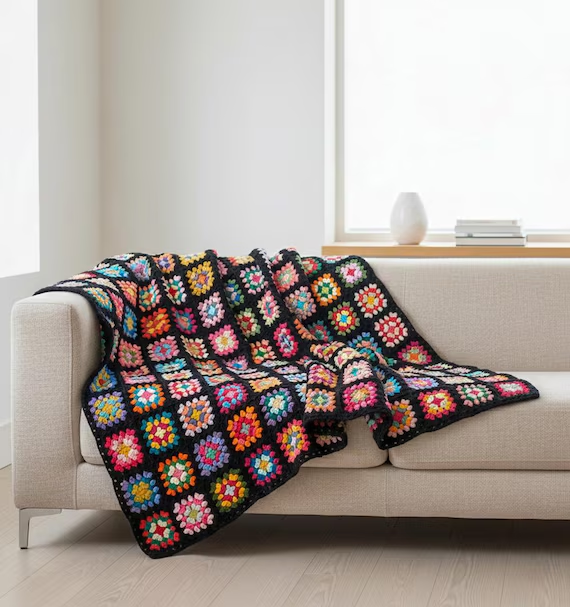
The blanket above proves it. Granny squares in a dozen colors, joined into a grid that could have been made in 1974 or 2024. The black border contains the chaos. The white sofa sets it free. This is the opposite of a trend. This is a time machine — a piece of the past that the present hasn't figured out how to improve.
And that's the point. Some things don't need improving. The granny square doesn't need innovation. It needs repetition. It needs hands that remember the pattern even when the mind is somewhere else. It needs women who understand that the most radical act in a world of constant upgrades is to keep making the same beautiful thing, over and over, until it outlasts you.
The Hook as Compass
Here's the final secret, and it's the one that contradicts everything the productivity industry wants you to believe:
The women who never outgrow crochet aren't hobbyists. They're philosophers who use fiber instead of words.
They've figured out that the hook isn't a tool for making blankets. It's a tool for making sense. Of time. Of loss. Of the particular loneliness that comes from being the only person in your house who remembers how the story started. The hook moves, and the story continues. The yarn runs out, and you join a new color. The pattern repeats, and so does the year. And somehow, in the repetition, meaning accumulates.
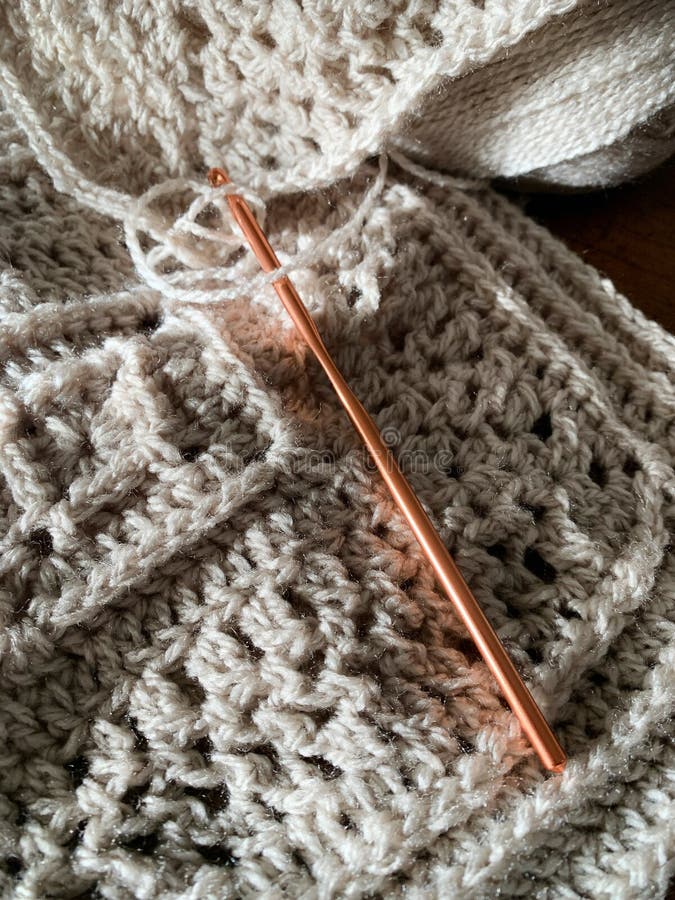
The copper hook above understands this. It rests on grey wool like a punctuation mark in a sentence that has no end. The stitches around it are tight where the maker was focused, loose where she drifted into thought. This isn't a work in progress. It's a thought in progress. The blanket will be finished eventually. But the thinking — the slow, looping, meditative thinking — that continues as long as the hands can hold the hook.
And that is why some women never outgrow crochet. Not because they're stuck in the past. But because they've finally arrived at a place where the past, the present, and the future are all held in the same loop.
Your Hook Manifesto
So here's your homework. Not a pattern. A philosophy.
Pick up the hook you put down. Not because you have time. Because you have finally learned that time isn't something you find. It's something you make, loop by loop, row by row.
Start the project that scares you. The complex pattern. The large blanket. The thing that will take six months in a world that wants everything in six days. The slowness is the gift.
Teach someone. Not because crochet needs saving. Because the transfer of knowledge — hand to hand, loop to loop — is the only immortality that actually works.
Protect the WIP. The half-finished blanket on the chair. The scarf with the dropped stitch you haven't fixed. The project that waits patiently while you live your life. These aren't failures of completion. They're proof of continuation.
May your hooks stay warm. May your yarn never tangle beyond saving. And may you be one of the women who never outgrows crochet — not because you refuse to grow, but because you finally grew into exactly the person the hook was waiting for.