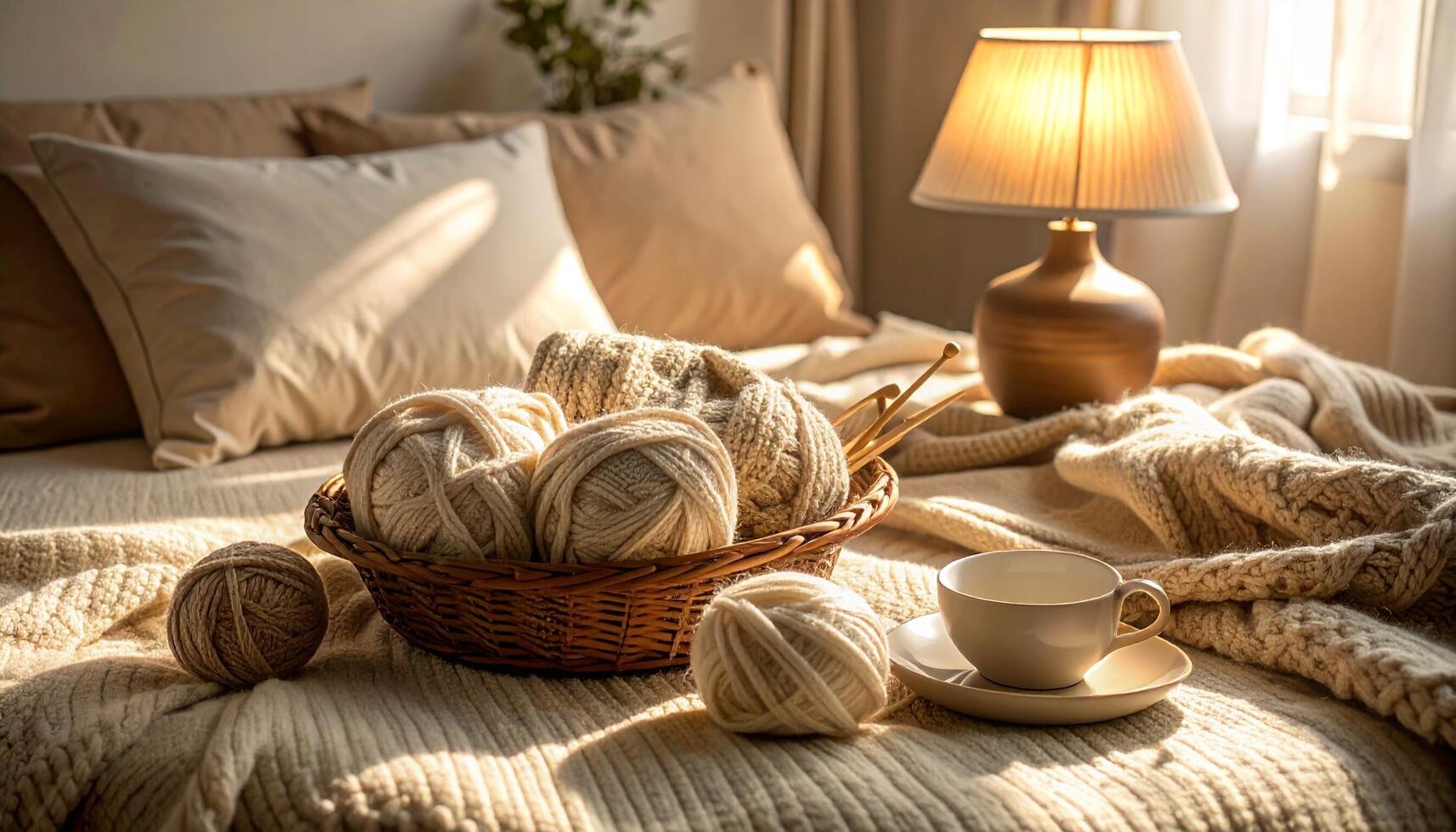
Or: The Hook That Hooks You BackThere is a moment in every crocheter's life that she rarely talks about. It happens quietly, usually around 9 p.m., when the house has settled into its nighttime breathing. She is holding a hook and a half-finished square of acrylic yarn that cost $2.99. The television is on but she is not watching. Her husband has asked her three times whether she wants tea, and she has answered "maybe" three times without looking up.She is not making anything important. A coaster, perhaps. A blanket for a baby who is not yet born. A granny square that will join forty-seven others into something she will give to someone who will say "thank you" and then store it in a closet.And yet—here is the strange part—she is happier in this moment than she was at her own birthday dinner.
The Mathematics of Impossible Calm
Crochet should not work as therapy. Think about what it actually is: a sharpened metal stick, a length of twisted fiber, and the repeated instruction to pull one loop through another. For hours. Sometimes for years. By any rational measure, this is the definition of tedium.But the body disagrees with the mind. The body, it turns out, has been waiting for exactly this kind of tedium.When you crochet, your hands move in a pattern just complex enough to occupy the part of your brain that worries, but not so complex that it demands real concentration. The rhythm—yarn over, pull through, yarn over, pull through—creates a cadence that your nervous system recognizes before your conscious mind does. It is the same cadence as rocking a baby. As walking on sand. As the sound of rain on a roof when you do not have to go anywhere.Neuroscientists have a term for this: predictive processing. The brain is a prediction machine, constantly guessing what will happen next. When the world is unpredictable—emails, traffic, news, children—the brain burns glucose at a furious rate. Crochet gives the brain exactly what it craves: a future it can see coming. Loop three will follow loop two. The stitch will be the same as the last one. The hook will not surprise you.And in that small, artificial certainty, the shoulders drop.
Crochet should not work as therapy. Think about what it actually is: a sharpened metal stick, a length of twisted fiber, and the repeated instruction to pull one loop through another. For hours. Sometimes for years. By any rational measure, this is the definition of tedium.
But the body disagrees with the mind. The body, it turns out, has been waiting for exactly this kind of tedium.
When you crochet, your hands move in a pattern just complex enough to occupy the part of your brain that worries, but not so complex that it demands real concentration. The rhythm—yarn over, pull through, yarn over, pull through—creates a cadence that your nervous system recognizes before your conscious mind does. It is the same cadence as rocking a baby. As walking on sand. As the sound of rain on a roof when you do not have to go anywhere.
Neuroscientists have a term for this: predictive processing. The brain is a prediction machine, constantly guessing what will happen next. When the world is unpredictable—emails, traffic, news, children—the brain burns glucose at a furious rate. Crochet gives the brain exactly what it craves: a future it can see coming. Loop three will follow loop two. The stitch will be the same as the last one. The hook will not surprise you.
And in that small, artificial certainty, the shoulders drop.
What the Long-Time Crocheters Actually Say
I started noticing something after speaking with women who have crocheted for thirty, forty, fifty years. They do not talk about the finished objects. They almost never mention the blankets or the baby booties. Instead, they describe the act in the same language, as if they all attended the same secret school of description.One woman in her seventies told me she still carries a hook in her handbag because "you never know when a panic attack will arrive, but you always know where row seventeen is." Another said she taught her daughter not because she wanted an heir to the craft, but because she needed someone to understand why the sofa had to be positioned under the lamp. A third, who had made over four hundred afghans, could not remember where a single one of them lived now. "I don't make them to keep," she said. "I make them to stay sane."It is not about the yarn. It is about the continuity. These women have found a tool that does not break, does not expire, and does not require a subscription. It only asks that you show up.
I started noticing something after speaking with women who have crocheted for thirty, forty, fifty years. They do not talk about the finished objects. They almost never mention the blankets or the baby booties. Instead, they describe the act in the same language, as if they all attended the same secret school of description.
One woman in her seventies told me she still carries a hook in her handbag because "you never know when a panic attack will arrive, but you always know where row seventeen is." Another said she taught her daughter not because she wanted an heir to the craft, but because she needed someone to understand why the sofa had to be positioned under the lamp. A third, who had made over four hundred afghans, could not remember where a single one of them lived now. "I don't make them to keep," she said. "I make them to stay sane."
It is not about the yarn. It is about the continuity. These women have found a tool that does not break, does not expire, and does not require a subscription. It only asks that you show up.
Why Crochet Stays With You for Life
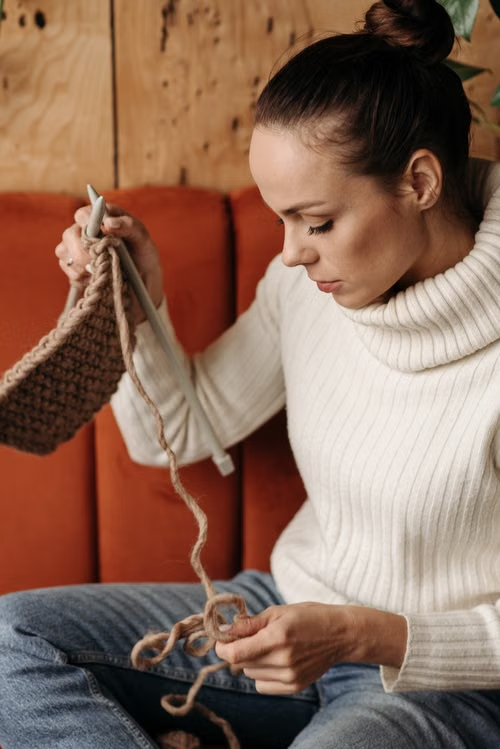
If you are wondering whether this craft is worth learning—or worth returning to after a long pause—here is what decades of practice actually deliver. Not the romantic version. The practical one.It creates routine without rigidity. You do not need to crochet at the same hour every day. You do not need a studio or special shoes. You need ten minutes and a chair. The habit forms not because you force it, but because the object itself calls you back. You want to see the next row. Then the next. Before you know it, the evening has shape.It reduces stress through motion, not medication. The repetitive hand movements lower cortisol. Studies on repetitive textile crafts show measurable decreases in heart rate and blood pressure after twenty minutes of work. You are not relaxing because you are thinking happy thoughts. You are relaxing because your body is too busy counting stitches to manufacture anxiety.It gives visible progress in a world of invisible work. You answer emails and they disappear into the void. You cook dinner and it is eaten. You crochet a row and it stays. The blanket grows at the edge of your vision, proof that time spent on yourself is not time wasted. For women who spend their days serving others, this visible, tactile progress is not trivial. It is evidence.It builds confidence through failure that is cheap. A dropped stitch costs nothing. Ripping back three rows takes minutes, not months. Crochet teaches your nervous system that mistakes are fixable, that perfection is unnecessary, and that starting over is not the same as failing. That lesson migrates. Women who crochet often report feeling calmer about professional setbacks—not because they are detached, but because they have practiced recovery on a small scale ten thousand times.It creates meaningful gifts without bankrupting your calendar. A store-bought present requires a trip, a decision, a wrapping. A crocheted dishcloth requires fifteen minutes and the willingness to say "I made this for you." The recipient rarely understands the time invested, but the giver always does. And the act of giving something your hands touched changes the chemistry of the relationship. It is a small, domestic magic that cannot be replicated by a gift card.
If you are wondering whether this craft is worth learning—or worth returning to after a long pause—here is what decades of practice actually deliver. Not the romantic version. The practical one.
It creates routine without rigidity. You do not need to crochet at the same hour every day. You do not need a studio or special shoes. You need ten minutes and a chair. The habit forms not because you force it, but because the object itself calls you back. You want to see the next row. Then the next. Before you know it, the evening has shape.
It reduces stress through motion, not medication. The repetitive hand movements lower cortisol. Studies on repetitive textile crafts show measurable decreases in heart rate and blood pressure after twenty minutes of work. You are not relaxing because you are thinking happy thoughts. You are relaxing because your body is too busy counting stitches to manufacture anxiety.
It gives visible progress in a world of invisible work. You answer emails and they disappear into the void. You cook dinner and it is eaten. You crochet a row and it stays. The blanket grows at the edge of your vision, proof that time spent on yourself is not time wasted. For women who spend their days serving others, this visible, tactile progress is not trivial. It is evidence.
It builds confidence through failure that is cheap. A dropped stitch costs nothing. Ripping back three rows takes minutes, not months. Crochet teaches your nervous system that mistakes are fixable, that perfection is unnecessary, and that starting over is not the same as failing. That lesson migrates. Women who crochet often report feeling calmer about professional setbacks—not because they are detached, but because they have practiced recovery on a small scale ten thousand times.
It creates meaningful gifts without bankrupting your calendar. A store-bought present requires a trip, a decision, a wrapping. A crocheted dishcloth requires fifteen minutes and the willingness to say "I made this for you." The recipient rarely understands the time invested, but the giver always does. And the act of giving something your hands touched changes the chemistry of the relationship. It is a small, domestic magic that cannot be replicated by a gift card.
The Geometry of Control
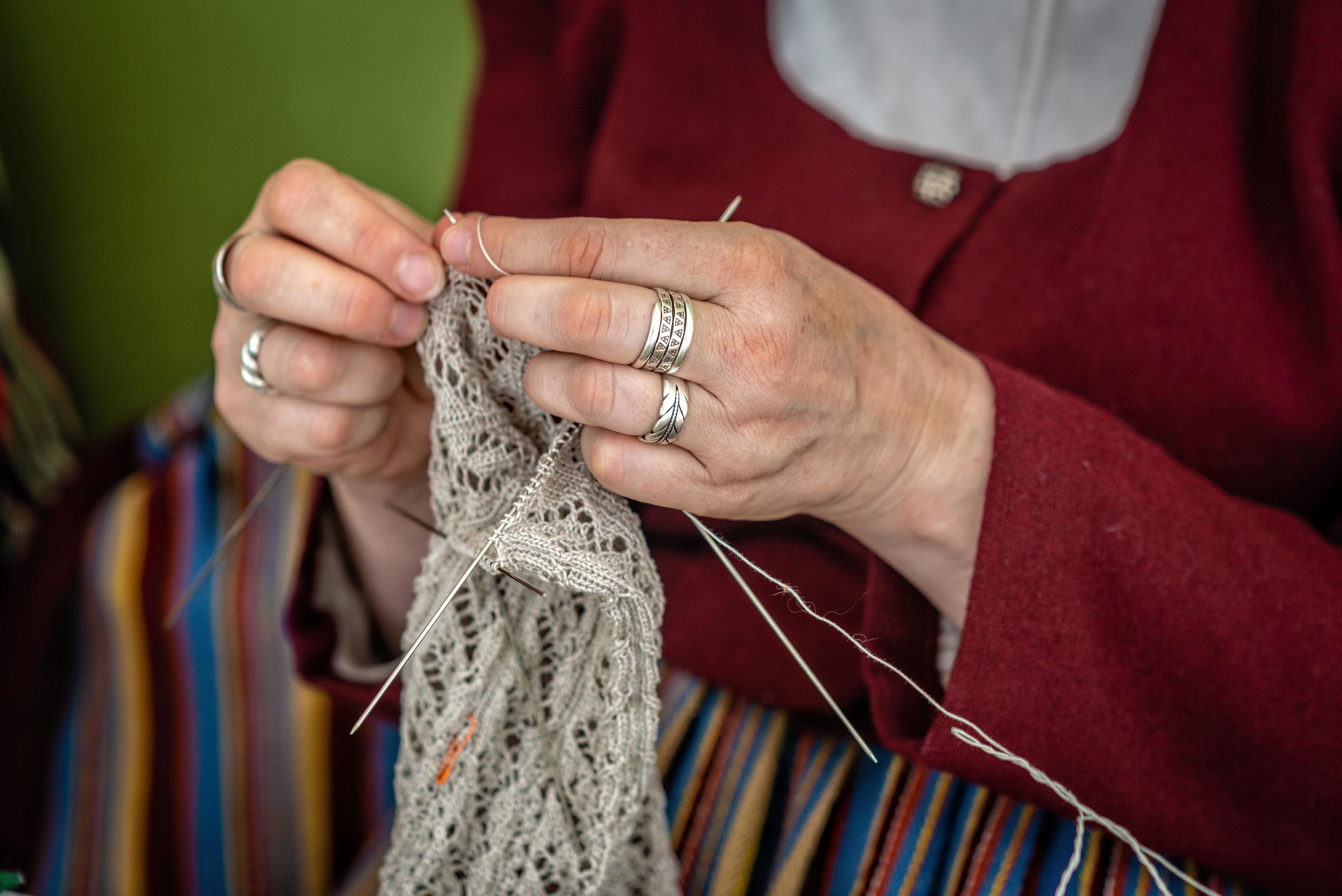
Life offers very few guarantees. Children grow in directions you did not predict. Marriages shift. Bodies change without permission. Careers stall or accelerate or disappear entirely. The world is a river, and most of us are trying to build houses on its banks.Crochet offers the opposite: a world where every decision is reversible. Where a mistake is just a loop you can undo. Where the finished object is exactly the size you decided it would be, in exactly the color you chose, with exactly the border you planned.This is not trivial. For women who spend their days managing the chaos of other people's needs—children, parents, colleagues, pets—the ability to create something that obeys them is not a hobby. It is a restoration of order.A crocheted blanket does not talk back. It does not need a snack. It does not reschedule the meeting. It simply grows, row by row, in direct proportion to the time and attention you give it. In a life full of variables, crochet is a constant. And constants, it turns out, are what keep people sane.
Life offers very few guarantees. Children grow in directions you did not predict. Marriages shift. Bodies change without permission. Careers stall or accelerate or disappear entirely. The world is a river, and most of us are trying to build houses on its banks.
Crochet offers the opposite: a world where every decision is reversible. Where a mistake is just a loop you can undo. Where the finished object is exactly the size you decided it would be, in exactly the color you chose, with exactly the border you planned.
This is not trivial. For women who spend their days managing the chaos of other people's needs—children, parents, colleagues, pets—the ability to create something that obeys them is not a hobby. It is a restoration of order.
A crocheted blanket does not talk back. It does not need a snack. It does not reschedule the meeting. It simply grows, row by row, in direct proportion to the time and attention you give it. In a life full of variables, crochet is a constant. And constants, it turns out, are what keep people sane.
The Legacy No One Asked For
There is a final secret, and it is the one that keeps women crocheting into their eighties.They know, even if they do not say it, that the blanket they are making will outlast them. The baby who receives it will grow into a teenager who spills soda on it. That teenager will become an adult who washes it carefully and folds it at the back of a closet. That adult will one day hold it and remember a grandmother they can no longer call.Crochet is slow because it is supposed to be slow. It is not about the finished object. It is about the time embedded in the object. Eighty hours of attention, compressed into wool. Eighty hours of someone thinking about you, even if you never knew it.
There is a final secret, and it is the one that keeps women crocheting into their eighties.
They know, even if they do not say it, that the blanket they are making will outlast them. The baby who receives it will grow into a teenager who spills soda on it. That teenager will become an adult who washes it carefully and folds it at the back of a closet. That adult will one day hold it and remember a grandmother they can no longer call.
Crochet is slow because it is supposed to be slow. It is not about the finished object. It is about the time embedded in the object. Eighty hours of attention, compressed into wool. Eighty hours of someone thinking about you, even if you never knew it.
The Hook That Hooks You Back
So why does it become a lifelong habit? Because crochet is not a hobby. It is a relationship. It is the friend who is always available at 10 p.m. It is the therapist who charges nothing and never interrupts. It is the proof that you were present in your own life, even when it felt like you were only surviving it.The women who crochet for decades are not women with extra time. They are women who have figured out that some things cannot be bought, optimized, or explained. They have found a way to hold time in their hands, loop by loop, and make it into something warm.And when the world feels too loud, too fast, too much—they reach for the hook. Not because they have nothing else to do. Because it is the one thing that has never let them down.
So why does it become a lifelong habit? Because crochet is not a hobby. It is a relationship. It is the friend who is always available at 10 p.m. It is the therapist who charges nothing and never interrupts. It is the proof that you were present in your own life, even when it felt like you were only surviving it.
The women who crochet for decades are not women with extra time. They are women who have figured out that some things cannot be bought, optimized, or explained. They have found a way to hold time in their hands, loop by loop, and make it into something warm.
And when the world feels too loud, too fast, too much—they reach for the hook. Not because they have nothing else to do. Because it is the one thing that has never let them down.